May 31, 2004
On Memorial Day
I didn't sleep well last night, and woke up about 4 a.m. to a restless wind blowing outside my window. I knew we were due heavy storms, and the air seemed to echo how I felt. I went outside and sat on my porch, listening to the silence of a small town, scattered safety lights breaking the darkness and casting the shadows of pine trees across my front yard. Off to the west, bright flashes of light pulsed over the tops of the trees, getting closer. Slowly the scene brightened, almost imperceptibly, until finally the first chirping of birds heralded a deeply gray and moody dawn. Then, directly across from me, a bolt of lightning split the sky in two, barely slashing its ragged way to the ground before thunder crashed and rain hit. I went inside, and sat on the floor behind my glass storm door while the storm raked through. Splashes of water flew through the little space where the door doesn't quite meet the sill, and dampened my feet.
I saw no more bolts of lightning, but sheets of it whitened the sky over and over. The rain became so heavy I could barely see the cemetery across the road. Once the light was not white, but sickly green, hanging in the air for two or three seconds, a faint sizzling sound threading through it. The electricity went off. Twice more in the next 10 minutes the green light replaced the white light, and each time the sizzling sound came from off to my left, even though the electricity was already out. Finally, as the sky still lightened, the thunder moved off and the rain diminished, I went back to bed. Sometime in the morning the electricity returned. I awoke to a cool house and a clock flashing 4:14 - the time since the power came back on.
The day is still gray, and more storms are expected. A lot of people will be holding their barbeques indoors, and the nearby lake beaches won't be as crowded. Perhaps some of those people will instead watch Memorial Day celebrations on television, or somehow spend time remembering the reason for Memorial Day.
I watched the dedication of the World War II memorial on Saturday, and cried through most of it. The wall of gold stars, hundreds of them, each representing at least 100 war dead, moved me the most. I don't think I will be able to stand in front of that, ever, and not cry. I haven't been able to when viewing the Vietnam War Memorial.
One thing I have done, repeatedly through the years, is take time out to visit war memorials. As the Civil and Revoluntionary wars are the only ones, until recently, fought on our land, those are the ones I visit the most. Each time, I try to envision real men, with real families, making the ultimate sacrifice. It's always overwhelming. So much death. Nearly 700,000 men died in the Civil War alone, and in a nation so much smaller then than now, that is an astronomical number. It is, in fact, half the total of all US military dead. What would our country have been like if all those men had lived, had children, contributed their talents and wisdom to our society? Or their criminality, because, truthfully, not all those who die in war are good men. But most are, average men doing the extraordinary, dying a death that can be gruesome or mundane, but all in the pursuit of what they believe is right. And you can't ask the question, what if they hadn't died?, without asking what would have happened to our nation if they had not accomplished their goals. Our goals.
So today is a time to honor the ones who have died to make this country ours, to give us our freedoms, to make it possible for us to gather with our families, to barbeque under an umbrella on a nasty day, to sit behind a storm door as dawn moves across the land, watching the rain and lightning. There is nothing we do that is not what it is because these men and women died.
I haven't any major plans for today - no parties, no visits to a war memorial or a parade or anything like that. Instead, today I'm going to work on my presentation for Spirit of America, in hopes of bringing some in the Birmingham community into the group to help our military in Iraq nurture peace and democracy. I think that's the best thing I can do to help insure that, next year, there are fewer war dead to memorialize than there otherwise might have been. Next year, I want to celebrate the safe return of our military, with the knowledge that they completed their mission with success and honor. I want as many soldiers, airmen, sailors, Marines, Coast Guard, and merchant marines as possible to be with their families on the next Memorial Day. I don't want the Gulf War I & II memorial to have so many gold stars.
Enjoy your day. It's a gift from history. And sometime during the day, listen to this.
[Last link via Sgt. Hook]
UPDATE: Some things to contemplate.
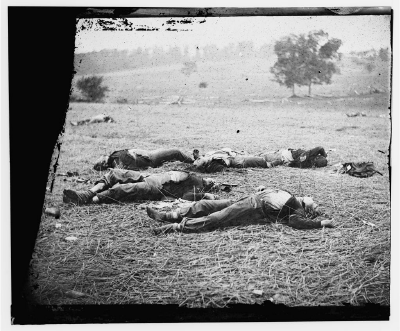
Civil War: Federal soldiers, McPherson Woods, 1863
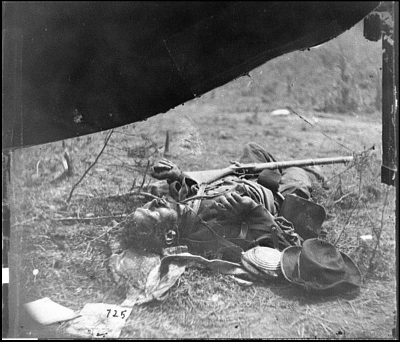
Civil War: Civil War soldier in Spotsylvania, 1864
Here is a letter from a Union surgeon to his wife, written from the battlefield at Gettysburg - posted by his great-great-grandson.

WWI: Americans burying their dead, Bois de Consenvoye, France, 8 Nov 1918

WWII: American soldiers, stripped of all equipment, lie dead, face down in the slush of a crossroads somewhere on the western front." Captured German photograph. Belgium, ca. December 1944.

"Standing in the grassy sod bordering row upon row of white crosses in an American cemetery, two dungaree-clad Coast Guardsmen pay silent homage to the memory of a fellow Coast Guardsman who lost his life in action in the Ryukyu Islands." Benrud, ca. 1945. 26-G-4739.
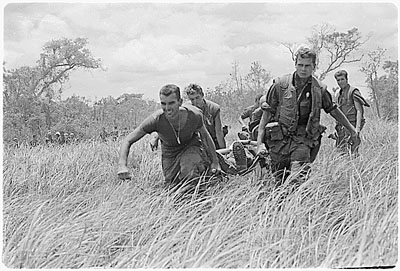
Vietnam War: Vietnam. Medical Evacuation. Marines of Company E, 2nd Battalion, 9th Marines, while under heavy firefight with NVAs within the DMZ on Operation Hickory III, are carrying one of their fellow Marines to the H-34. 07/29/1967
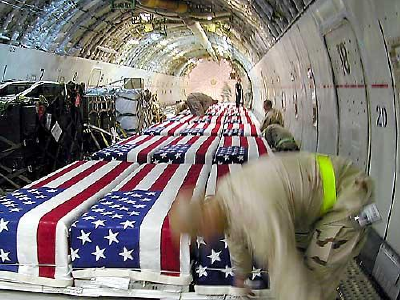
Operation Enduring Freedom: Flag-draped coffins are shown inside a cargo plane April 7 at Kuwait International Airport, in a photograph published Sunday. The photographer said she hoped the image would help families understand the care with which fallen soldiers are returned home.
First two photos from the Library of Congress collections.
Remember the living too
It's Memorial Day, a time to remember the Americans who died on battlefields across the world and at home to make this country what it is today - an entity more good than bad, a whole better for having all its parts, the strongest and best nation ever to grace the world stage. Take some time to pay homage in your own way - reading a book about their sacrifices, visiting a military cemetery, spending time with veterans, talking to your family members who have served, writing letters to soldiers far from home with little family support.
And take a little time to say a prayer for the ones who've come home, who find their world changed, and not necessarily in a good way. Sometimes the coming home is as hard as the being gone:
Like most soldiers here, Sgt. Jeremy Kerr, 26, says he is fine. He is happy to be safely home, watching afternoon cartoons with his young daughter, Alexus, and son, Jacoby.Sergeant Kerr says he is not getting counseling. He does not need it, he says. He says he has a deep faith in God, a Christian wife and a strongly supportive church.
Still, when he drives, he says, he finds himself scanning the roads, imagining bombs in bags of trash and potholes. Sometimes he studies Junction City rooftops for snipers. And he often wakes from dreams with the rattling boom of an explosion right beside him.
"My whole head will be ringing and buzzing like the real thing, and then I wake up," he said.
But this, he said, is an improvement. Sergeant Kerr came home to Junction City in February after an improvised bomb went off next to him in Iraq, sending shrapnel into his legs and leaving scars like lunar craters. The two Fort Riley soldiers beside him died.
For a week, he said, the image of a colleague with no legs and his face ripped apart haunted him. He could not sleep.
He and his wife, Felicia, admit that they struggled to get along at first. He was in a wheelchair then, and Felicia had to tend to his every need. He could not go to the bathroom alone.
"He was kind of getting on my nerves, to tell the truth," Ms. Kerr said. "I had kind of gotten things set up around here, and I wasn't ready to do that, too."
"It drove me crazy, too," Sergeant Kerr said. "I felt worthless."
He was there because we sent him there. Spare a little time to thank him and all the others for what they've done.
UPDATE: If you came here from another site, you may want to check out my second Memorial Day post, here.
UPDATE II: I've put together a MS Word document listing all the organizations I know of that offer help to Iraqis or US troops in the war, based on posts at The Winds of Change and Blackfive. If any of you would like to have a copy for distribution in hard copy to people in your community, please let me know and I'll be happy to send it. Some day I'll learn how to convert to PDF, and just post it. Some day.
UPDATE II: Apparently "some day" is today! Here's the link to the PDF file, converted via Adobe's free online trial program.
May 30, 2004
NYT copy editor caught sleeping
At least I hope that's the reason for this headline:
Honk Kong Rally Signals Start of Turbulent Summer
I'm sure they'll change it soon, but that's very funny.
And yes, they do mean "Hong Kong". But it sounds like a King Kong rumble movie, doesn't it?
May 29, 2004
Update - not so infuriated
Yesterday I posted my initial email to a local television station written after I saw a segment on The Day After Tomorrow that I thought presented the movie as possibly having some basis in reality. They also used a screen shot of MoveOn.org, presented as a neutral environmental group, not the rabid political partisans they are. As I am wont to do, I waxed eloquent.
Now, about 24 hours later, I've had a couple of exchanges with various news people there, including the on-air reporter, and I wanted to let you know that it was a very good exchange. They were responsive, not particularly defensive, and in the second round of emails conceded that they could have made other choices in presenting the material that would have been more balanced. I don't have the impression that a conscious (or strong unconscious) bias was going on. I had been impressed with the station before, and this has increased my confidence in them as a genuinely professional news organization that wants to do their job well - which is to say, fairly and with balance. That's not to say they're perfect, but then, who is? At least they're not complacently convinced of their own perfection, like, oh, say... Eason Jordan, or Howell Raines.
One more reason to like Alabama.
UPDATE: Corrected "Howard" to "Howell". Yeesh. I never get his name correct the first time. This time I thought I was doing great because I had decided that last time I called him "Harold" when it was "Howard". No, no, no! Next time I'll look it up. I just need to remember: "Howell" as in "howling bad journalism". Think that'll work?
Maybe. Maybe not. Lately I've been typing "UDPATE" each time and have to retype it. There could be no hope for me.
Amazing that Howling Howell is from Alabama. No wonder he's steeped to his eyeballs in Liberal White Man's Guilt. Burned him in the Jayson deal, didn't it? Heh.
No...no, I wouldn't say that
|
Which poem are you? Dover Beach by Matthew Arnold You're probably strongly political, and a pacifist. Hey, and you're also slightly depressing. You think a lot of things suck and are pointless. Congratulations!
|
|
Click Here to Take This Quiz Brought to you by YouThink.com quizzes and personality tests. |

Strongly political, but ... pacifist? Hardly. Nor am I a warmonger. Just a compassionate conservative. Ha. I think very few things are pointless, I'm not generally depressing OR depressed, although sometimes I am. Those are pretty rocks, though. If you want to read the actual poem, it's in the "More" section. It's actually pretty good.
(Found at Amy Loves Books, which I found via Tony Woodlief. And who knows where I found him - I don't even have a cat!)
English Poetry III: From Tennyson to Whitman.
The Harvard Classics. 1909–14.
705. Dover Beach
Matthew Arnold (1822–1888)
THE SEA is calm to-night,
The tide is full, the moon lies fair
Upon the straits;—on the French coast the light
Gleams and is gone; the cliffs of England stand,
Glimmering and vast, out in the tranquil bay. 5
Come to the window, sweet is the night air!
Only, from the long line of spray
Where the sea meets the moon-blanch’d land,
Listen! you hear the grating roar
Of pebbles which the waves draw back, and fling, 10
At their return, up the high strand.
Begin, and cease, and then again begin,
With tremulous cadence slow, and bring
The eternal note of sadness in.
Sophocles long ago 15
Heard it on the Ægæan, and it brought
Into his mind the turbid ebb and flow
Of human misery; we
Find also in the sound a thought,
Hearing it by this distant northern sea. 20
The Sea of Faith
Was once, too, at the full, and round earth’s shore
Lay like the folds of a bright girdle furl’d.
But now I only hear
Its melancholy, long, withdrawing roar, 25
Retreating, to the breath
Of the night-wind, down the vast edges drear
And naked shingles of the world.
Ah, love, let us be true
To one another! for the world, which seems 30
To lie before us like a land of dreams,
So various, so beautiful, so new,
Hath really neither joy, nor love, nor light,
Nor certitude, nor peace, nor help for pain;
And we are here as on a darkling plain 35
Swept with confused alarms of struggle and flight,
Where ignorant armies clash by night.
May 28, 2004
Infuriating local reporting
A local television news report on The Day After Tomorrow tonight set me off. I've written the reporter who made the report, copying it to the two people who anchor the news program. Here's the text of the letter:
Mr. Ward -I was very surprised by your report on the 6 p.m. news tonight about the new movie, The Day After Tomorrow. Specifically, I honestly was shocked by the poor reporting that threaded through it. The basic point you made, albeit without saying it directly, was that The Day After Tomorrow actually has something of value to say about the environment. You interspersed scenes from the movie, narrated with bits about how it could be true, with interviews with local people who have no credentials that I could see to be making judgments about the validity of the movie's claims. And then, you capped it off with a screen shot of MoveOn.org, a flagrantly leftist organization centered right now on defeating President George Bush in the November election. They are NOT an environmentalist organization, and no organization of any credibility. Their urging to watch the movie is grounded in whatever harm it can cause the current administration if people believe the movie, not in any kind of genuine concern for the environment or any knowledge of environmental truth.
It wouldn't have taken you very long to track down some more credible sources. In ten minutes online, I found these:
------------------------------
* http://www.nytimes.com/aponline/science/AP-Global-Warming.htmlGroup Uses Film to Oppose Global Warming
...Environmentalists admit that many of the special-effects scenarios featured in ``The Day After Tomorrow'' are far-fetched...
``This movie distorts global warming, obviously,'' said Maureen Drouin, northeast regional representative of the Sierra Club. ``It's a disaster movie. But we also feel that the Bush administration is distorting the science on global warming.``
...To Jon Reisman, it is all just so much hype. Reisman, associate professor of economics and public policy at the University of Maine at Machias, said environmentalists' activities around ``The Day After Tomorrow'' fit a pattern in the development of climate change policy.
``To get it on the agenda,'' he said, ``you have to make people think something terrible is happening.''
* http://www.nytimes.com/reuters/arts/entertainment-film-controversy.html
Controversy Doesn't Spell Hit at Box Office
The past few weeks have witnessed a couple of classic ``controversies'' as the talking heads -- or make that butting heads -- have had at it over the Walt Disney Co.'s refusal to allow Miramax Films to distribute ``Fahrenheit 9/11.'' And they then moved on to debate whether 20th Century Fox's multimillion-dollar disaster pic ``The Day After Tomorrow'' is actually an environmentalist Trojan horse...
...initial media reports suggested that Fox also was shying away from any suggestions that ``Day'' was an environmentalist tract -- even as Al Gore and MoveOn.org were piggybacking on the movie's New York premiere with their own parallel event...
A popcorn movie, ``Day'' may be even more subversive than the unapologetically partisan ``Fahrenheit'' because it takes potshots at a Dick Cheney-like vice president who has resisted efforts like the Kyoto Accords, designed to combat global warming.
* http://film.guardian.co.uk/features/featurepages/0,4120,1215824,00.html
A hard rain's a-gonna fall
(writer is environmentalist George Monbiot)
...The Day After Tomorrow is a great movie and lousy science...
So will The Day After Tomorrow wake people up to the realities of global warming? The danger is that the movie bears so little relation to the science that it will encourage people either to dismiss the entire climate change story as fantasy, or to keep waiting for the effects they have seen in the film before they accept that climate change is really happening. On the other hand, the film makes the subject much harder to ignore.
------------------------
You can hardly accuse The New York Times, Reuters and UK's The Guardian of being patsies for conservatives, or of being in bed with big business and against environmentalism. In fact, I can extensively document their liberal bent, and support of most liberal political agendas. And even THEY say the movie is "lousy science", "distorts global warming", and "takes potshots at a Dick Cheney-like vice president".
And this comes from Patrick J. Michaels, a "senior fellow in environmental studies at the Cato Institute and author of the upcoming book, Meltdown: The Predictable Distortion of Global Warming by Scientists, Politicians and the Media":
-------------
http://www.usatoday.com/news/opinion/editorials/2004-05-24-michaels_x.htmAs a scientist, I bristle when lies dressed up as "science" are used to influence political discourse. The latest example is the global-warming disaster flick, The Day After Tomorrow.
This film is propaganda designed to shift the policy of this nation on climate change. At least that's what I take from producer Mark Gordon's comment that "part of the reason we made this movie" was to "raise consciousness about the environment."
Fox spokesman Jeffrey Godsick says, "The real power of the movie is to raise consciousness on the issue of (global warming)."
---------------As for MoveOn.org, here's a little bit of info for you:
-------------------
http://www.moveonpac.org/On April 20th, Bush/Cheney '04 campaign manager Ken Mehlman told associates that "MoveOn.org is a huge threat and has hurt the president." We're launching a campaign to prove him right -- a $50 million grassroots fundraising drive we call 50 for the Future. Together, over 500,000 of us will chip in to elect John Kerry, support progressive officials for office, and run ads to counter President Bush's spin.
----------------And even THEY say the movie is pathetic science:
-------------------
This weekend, Hollywood will be releasing a summer blockbuster movie that's making the Bush administration very nervous. In fact, they'd rather you didn't see it at all. Why? Because it's a disaster movie about a potential climate crisis.
While "The Day After Tomorrow" is more science fiction than science fact, everyone will be talking about it — and asking "Could it really happen?" This is an unprecedented opportunity to talk to millions of Americans about the real dangers of global warming and expose President Bush's foot-dragging on the issue.
---------------
Let me just repeat that one section for you:
*"The Day After Tomorrow" is more science fiction than science fact*
So please, explain to me, when all this information about the movie, about MoveOn.org, is available out there, did you do a piece creating such a completely false picture? At best, it's poor reporting. At worst, it's flagrant bias toward a liberal environmentalist agenda. You tell me.
best,
Susanna Cornett
Columbiana, AL
bias.blogfodder.net
There you have it. And no, I don't know why I signed off "best". I couldn't think of another closing that was polite but less friendly. It'll do. Besides, I do wish him the best, which includes a more accurate and impartial approach to his reporting. I'm trying really hard, by the way, not to think that his report has something to do with the fact that he grew up and started his career in the NYC area. He's not a Yankee liberal. He's not a Yankee liberal...
UPDATE: I have to confess. The poor reporting connecting the movie to local things was just... sad, and I was sitting there shaking my head, thinking, "This reporter is incompetent or at least was today." Then he popped up that screen shot of MoveOn.org, acting as if it were some credible environmentalist organization, and I just blew. It was MoveOn that did it.
UPDATE II: My brother. He thinks he's so funny. What's annoying is that sometimes he actually is.
I was yelling at him (typing in all caps) on MSN Messenger about this reporter flashing the screen shot of MoveOn.org, and doing that biased piece on the environment. Here's our exchange: (NOTE: It's in the extended entry, sorry to be confusing but this post got too long and I wanted to put in another update. I trust your ability to figure it out.)
UPDATE III: I just got an email back from one of the anchors at the television station. I won't post it, since I don't have his permission, but I was impressed with his concern and tone. He had questions about the piece too, and said it would be followed up. He didn't trash anyone, but I also don't think it was a "pacify the viewer" email either. My appreciation for the station has gone up; definitely recovered from the blow of the movie piece. Unless, of course, they go off the deep end again. But the channel, NBC 13, is the best local news broadcast in the market, so I'm glad to see that extends to their anchors as more than on-air personalities.
I can sleep now.
:D
Alan says: clearly, you are unconcerned about the environment Susanna says: yes Susanna says: of course I am Alan says: you seem to have a bit of an attitude about it Susanna says: it was just that screen shot of MoveOn.org that tipped me over Susanna says: !!!!!!!!!!!!!!!!!!!!!!!!!!!!!!!!!!!!!!!!!!!!!!!!!!!!!!!!!!!!! Alan says: lol Alan says: it's not in your favorites? Susanna says: DO YOU KNOW WHAT IT IS?! Alan says: must you shout? Alan says: do I know what what is? Susanna says: MoveOn.org!! Alan says: you're excitable aren't you? Alan says: yes, I do Susanna says: I'm just infuriated to have seen a screen shot of that leftist evil group flashed on my TV screen, in Alabama!, as if it were some kind of genuine environmentalist group Alan says: lol Susanna says: the Sierra Club would have been bad enough Susanna says: It would be like flashing up a website by Thierry Meyssan as a source for reasoned questions about 9/11 Alan says: I think it's pretty hard to argue against the fact we've had a pretty steady warm-up over the last several weeks Susanna says: LOL Susanna says: uhoh Susanna says: now that you mention it... Alan says: I mean, just a few weeks ago we were using the heater here Alan says: now it's the AC every day Susanna says: I'm going to use that
And so I did.
See what I mean?
Turning in my reporter credentials
Remember the huge fire just 1/2 mile from me that I told you I completely missed on Saturday?
There's a photo and article on it on the front page of the Shelby County Reporter, my local weekly paper. It's clear that my reportorial instincts haven't just lessened, they've rolled over and sighed their last. Pathetic. There were even firefighters in uniform to watch, and I missed it entirely.
However! It's possible my writing skills are not so thoroughly compromised.
I've decided to learn my county, so I'm trying to remember to read the whole paper every week. It's a start. In that spirit, I dived into this article, about development planning in the county. For context: Shelby County is directly south of B'ham, which is expanding mostly south. The northern part of the county is booming with development while the southern part, including Columbiana, the county seat, is still quite rural in both population and feel. For those of you familiar with Louisville, KY, think about Oldham County. Columbiana feels very like LaGrange did when I worked for the Oldham Era back in the mid 80s. It's also about as far from the Big City, although Columbiana isn't right on an interstate.
The development article was interesting to me too because development was always a huge topic in Lexington-Fayette County when I worked for their city/county council. I know a little bit about it, at least the general debates and concerns, so I wanted to know what was going on here. As far as their revision of the comprehensive plan, I question the cluster concept they're touting as the new-thing-taking-us-back-to-the-old-thing, i.e. relatively self-contained neighborhoods. It works in small doses, but this is one instance where you built it, they won't come. Most especially they want to redirect traffic off the big corridors and establish satellite shopping areas in these "made" communities, to reduce the volume on the big corridors.
Clue: You're about two decades too late.
Anyway, enough analysis of their plan. What first caught my eye about the article was, unsurprisingly, the lead (or lede, which I never called it in all my years of journalism):
James Ponseti thinks of the clock tower in the town square from the movie "Back to the Future" when he describes his vision of the communities supported by Shelby County's new comprehensive plan, which has not been adopted yet.
A nice snappy reference to an old movie, an understandable sentence, gets a lot of necessary bits in there. But... the writer never mentions the movie again! He doesn't explain the movie, he doesn't tell you when it came out, he doesn't tell you why dude thinks about the movie. Somehow he just does, that's all, and it could just as well be tomatoes or steel girders he thinks of. At least, that's true for all you, the reader, know.
People, when you open an article with a comparison to something, you have to play out the comparison elsewhere in the piece. If you're really good, you can dot references through the piece and actually close with a line harking back to the lead. It has to be done with a steady hand, though, because too much becomes parody. Of course, too little leaves the reader hanging, saying, "wha?" As is the case here.
I can't completely fault the writer, without knowing more. Sometimes editors, especially not very good editors, will gut a metaphor or simile without so much as a tremor of remorse. Perhaps they don't even notice, which is even worse. I once wrote a long feature piece on a local attorney, for a (tiny tiny tiny) newspaper, and constructed what I thought was a lovely description of the woman. It was all interconnected, building to a crescendo. Oh, I was full of myself in those days. When I finally saw it pasted on the page, after my editor finished with it, the thing was eviscerated. No other word for it. She thought it was too long, and just sliced and diced without giving it back to me for rewrite, or even smoothing of the ragged, bloody edges. I was ashamed to see it run. I learned a lesson.
The main one being, get out of Dodge. Which I did, but that's another story.
So maybe the writer did have other movie references in the story, and the editor showed his (her?) incompetence. But either way, this actually pretty good story, which explains fairly complex doings in clear, easy to follow language, in the final analysis leaves you saying, "wha?" because of that obscure, disconnected reference to a 1980s movie.
But then, I miss massive fires, which are a bit larger than similes. Or metaphors, for that matter.
An interesting thought
Should we be thankful for violent video games, instead of horrified?
Doug Kerns's TCS article on the wussification of cartoons in the 70s, and Gen X's ability to become decent people anyway, is well worth reading if only for this point:
[I]f we accept that sex differences are something to be celebrated, not denied, then we can get back to the age-old task of taming - but not breaking - the male spirit.
I say, bravo to that. Let guys be guys! But it's the corollary to that statement that really caught my attention:
It's true that some notorious teen monsters (like Klebold and Harris from the Columbine tragedy) enjoyed violent shooting games - but so do most teenaged boys. Most likely those savage young men turned to video games as an outlet for the chaotic impulses that they could not control. Perhaps we should be grateful for games that transform adolescent rage into harmless electronic depictions on a screen. Perhaps transformation can succeed where suppression fails.
The official psychological term for it is displacement, "A psychological defense mechanism in which there is an unconscious shift of emotions, affect, or desires from the original object to a more acceptable or immediate substitute." The general trend is to think that violence begats violence, and there's possibly some validity to that. But I think equal attention needs to go to the therapeutic benefits of displacement, taking strong aggressive impulses and channeling them into play of some sort where no one gets truly hurt. Is it possible that some personalities will actually feed on the violence, and birth more violence as a result? Certainly. But what needs to be noted is that it's a refinement or amplification of an already present dysfunction, at least in my judgment. Klebold and Harris weren't charming, loveable little fuzzballs of compassion before they got their hands on guns and explosives.
The question to ask isn't, what is it about violence that twists little (or big) minds? The question to ask is, why does natural male aggression sometimes result in fine warriors like Pat Tillman, and other times in execrable fiends like Klebold and Harris? I think the answer lies outside the realm of applied violence itself, and rests in training and character, in the channeling of that aggression. And Kerns's article makes it clear what role something as simple as comics can play.
Something to think about.
Gnostics and nonsense
My brother Alan has a couple of excellent posts at theosebes. First, he links an article discussing why the so-called "lost books" of the NT weren't lost at all - they were deliberately excluded from the canon, for good reason, Dan Brown's Da Vinci Code notwithstanding.
Then he ruminates on the trend of rural churches to lose membership, some merging into larger congregations with newer buildings. It's a sad, in a way, but what's important is not where you meet or where your grandmother went to church, but who you worship and how you worship Him.
The church where I attended as a child had bare wood walls, a pot-bellied stove for heat and outdoor "facilities" when I started going there at 5 years old. It upgraded to air conditioning and electric heating over the years, and about the time I left for college they built a modern building with indoor restrooms and central air. A major improvement. But as Alan notes, the number of members is steadily declining, and in general the group is aging. Not many if any new families, or young children, attend there. Perhaps a new building would help. But I agree with Alan that I'm not sure there'll be a congregation there in 10 or 20 years. I guess that's the way time works. There'll be all kinds of new congregations popping up in places there weren't any before, and groups merging to make stronger and more effective groups. And that's a good thing.
Alan focuses on rural churches in his post, but I noticed a trend of empty church buildings in Newark too. There was one cathedral that you could see from miles away, a truly spectacular structure. But when you got close, you could see it was no longer in active use. I tend to think that the Lord's money is better spent other places than for a magnificent building, but as someone who appreciates the past, and admires historical ecclesiastical architecture for its sheer beauty (not present in most modern ecclesiastical structures), I regret the eventual loss of that building.
Gotcha!
It's about time this started happening, but it needs to happen a lot more:
A man who sent 850 million junk e-mails through accounts he opened with stolen identities was sentenced to up to seven years in prison on Thursday.
And specifically which ones did he send?
Earthlink said Carmack ran 343 illegal e-mail accounts under false names from 2002 until his arrest last May, using them to send unsolicited e-mail ads for things like get-rich-quick schemes and sexual enhancers.
But this is the best one of the lot:
Carmack told the judge he believed the case against him was overblown, saying there were no victims. "I obviously regret this whole involvement," he said.
Emphasis mine. How much bandwidth is used to send and store these things? How much time is taken up to delete them or develop software to stop them? How many people are duped, or have their computers damaged by them? Just with comment spam alone, I spend a couple of hours a week deleting it, putting the URLs on the MT Blacklist, and closing out the comments on posts where it was placed. I consider myself a victim, thankyouverymuch.
And it's not like it's a small problem either:
Spam last month accounted for two-thirds of all e-mail traffic, according to e-mail monitoring firm MessageLabs Inc. Things are even worse in the United States, where spam accounted for more than four in five e-mails, according to Message Labs...According to the firm, 83 percent of the e-mails it filtered last month for its mostly U.S.-based clients was spam. That was up from 78 percent in January, when the new anti-spam federal law, the CAN-SPAM Act, took effect...
There's also been increased use of Trojan horse programs designed to turn home Internet users into unwitting partners in spam delivery, he said. The programs allow spammers to hijack innocent people's computers in order to send spam.
What was that about victims?
Trying too hard, are we?
Roy Peter Clark is a senior scholar at the Poynter Institute, and a former jurist on a Pulitzer Prize selection committee. I'm sure he writes lovely, singing prose on most every occasion. In this article, he's discussing the startling fact that this year's Pulitzer Committee didn't award a prize for features despite having the usual three finalists for the award. Clark laments that the pieces are "way too long and difficult to read, devoid of memorable characters, and surprisingly weak in the use of language, indecisive about narrative structure". Fighting words. He especially decries the length of the pieces - each involving multiple articles - saying they would be better categorized as "explanatory journalism". He adds, "[t]hese three series can barely be called "features" by any definition of the newspaper feature story I understand."
To further reinforce his point, he draws this simile, referring to the one of the three finalists he likes best:
But to allow it to elbow its way through the features category is allow an elephant to race against gazelles in a broom closet.
And this man is bemoaning someone else's less-than-sterling prose? I'm sure if I read some of his features, I'd be just riveted. But this little creative effort dropped in his feature criticism piece just doesn't work. It's clunky, it makes no sense, and the visual imagery is difficult to construct. I know what he meant to say, but I greatly bemoan his effort to say it in a clever manner.
Which works better here: Physician, heal thyself? Or perhaps, he who is without sin, throw the first stone?
Well. Choosing the best descriptor is like trying to chase a greased pig through a traffic jam. Perhaps instead I will leave you with a moral:
Don't write poorly in an article criticizing someone else's writing.
I know, I know, "He who is without sin..."
A beautiful thing to see
Instapundit linked a Boston Herald editorial excoriating Al Gore, so naturally I had to go read it. You should too. My favorite piece?
The real disgrace is that this repugnant human being once held the second highest office in this great land.
Amen.
May 27, 2004
Axis to grind
As a new member of the Axis of Weevil, I feel obligated to answer Terry's Thursday Three. The fact that I'm tired from my first day back in the classroom for the summer has no bearing on my willingness to snatch up an easy post.
First, to prime the pump, go visit Charles. That should convince you that anything I post is a bounteous blessing in comparison. Ready? Good.
1) Who is the most peculiar person you know personally? Please give a short listing of their particular foibles you find most compellingly peculiar. Obviously, the more peculiar, the more prudent it will be to disguise their identity to some extent--giving their name, address, and aluminum-foil-hat communicator number is probably a bit too much information. You know how those people are.
That's a challenge. The most peculiar? Hmmm. It's a tie. One is a guy I went to school with, way back. He was tall, thin, always rumpled looking in a the-slacks-and-shirt-were-on-the-floor-together kind of way. He desperately wanted to marry but had no conversation or social skills. He would sit at the school's basketball games reading books like "How To Find A Wife". If a woman said hello, he was like leech. Once he called me to ask me to go out for pizza. I said no, he begged, I said no, he said it was his b-day and no one else would go, I said no (feeling very horrible and mean), he said please please and I said I have to work on a paper. I did, but it wasn't due for a while. However, I diligently started work on it as soon as I got off the phone, and didn't even go out with friends later because I had told him I was working on the paper.The other one was a science professor. The class was bizarrely easy, because he handed out worksheets that had text with blanks for some of the words. His lectures consisted of giving us the information to fill in the blanks. He was a nice man, in some ways, but very buttoned up. He was always dressed in a white dress shirt, dress slacks and a tie, very 50s looking with short hair. He was cheerful, always telling jokes that weren't funny except to him. He moved about the room with jerky movements, as if he needed just a little grease in his joints. He seemed somehow disconnected from reality, the kind of person who you suspected might have his mother mummified in the basement and played chess with her everynight, cheerfully. Just... odd.
2) What characteristic(s) about yourself do you think others might find just a tad bit peculiar?
Like the song says, where do I begin? I have a terrible time focusing on something, and tend to flit from project to project. I have hundreds of books I trail from state to state without reading, and big piles of fabric stashed in bins even though I haven't sewed in months (much). Once I move away from a place, I generally don't go back much, and it's like I've moved to a different world. I never want to move back to a place I've been before. Yet I almost obsessively keep mementoes from all the places I've lived. Zesta saltines with orange juice is one of my favorite snacks. No dipping, though. NO DIPPING! Dipping a cracker or cookie into liquid is an offense against mankind. I'm very friendly and outgoing when I meet people one on one or small groups, but I don't like parties and will mostly hide when I'm at one. I like privacy and could go several days without talking to other people and not mind it. I don't like coffee.
3) Knowing how Peculiar-Americans tend to have rather different ideas when it comes to politics, have you ever voted for a person who was identified as something other than a Republican, Democrat, Libertarian, or little-‘I’ independent?
No. I'm pretty much a straight-party voter, although I tell myself I'm not and prove it by turning each lever individually, instead of pulling the "straight party" lever. I suppose it's one of my peculiarities.
Did I mention I love ginger in almost any way it can be served, except pickled?
R.I.P.
Winfred Duff, the father of my close friend Melody, passed away yesterday at the age of 80. He had been ill for some time, so it wasn't unexpected. He just slipped away peacefully as Melody and her husband Morris stood beside his bed, at their home. It was a quiet and dignified death after a long, happy life taking care of his family, helping others and attaining wide professional acclaim in his home town. I didn't know him until he moved to stay with Melody after her mother's death 7 years ago, but I'm glad I got to know him then. He was a kind, funny and sharp gentleman, always glad to see me when I visited, always interested in what was going on with me, and interested in the world around him. I could see a lot of him in Melody, who has been a dear friend for the past 9 years.
Rest in peace, Winfred. I'm glad I knew you.
A quilt for the lost ones
A young woman in Florida is making a lap quilt for the families of each soldier who has died in Iraq. So far she's made 500, sometimes up to 7-8 per day, with the help of people who send her quilt tops and fabric:
"It’s all about sacrifice," explains 19-year-old Jessica Porter of Hudson, Florida. Americans who have paid the ultimate price in Iraq "have sacrificed everything to protect us. I just wanted to give their families something respectful in return."...With your help, Jessica has already completed and sent close to 500 quilts to families as of May 15. Thanks to you, she receives 10-15 packages per day of fabric and quilt tops.
If you're interested in helping her out, her address is posted on the site with some information about what fabric she needs. It doesn't mention dollar donations.
What a huge task. What a great gesture.
May 26, 2004
Religion at the polls
Tuesday is primary day in Alabama, and you can tell by the advertisements on television. I've only noticed two races with heavy television campaigns, so I'm assuming those are the two most hotly contested. But only one of them is all about who's the most on God's side.
What a change from New Jersey.
I'm sure you remember the furor over the Ten Commandments and Alabama Supreme Court Chief Justice Roy Moore last fall. He had a large statue featuring the Commandments installed in the rotunda of the Alabama Judicial Building, then refused to remove it when ordered to do so by a federal judge. His fellow justices voted to comply with the federal ruling, and the statue was removed. Last November, Moore was thrown off the court by a judicial ethics panel for refusing to comply with a ruling from a higher court.
Now, in this political season, the situation is heating up again:
Supporters of former Chief Justice Roy Moore have lined up to run for one congressional seat and all three state Supreme Court seats up for election.
A number of business groups are supporting the non-Moore Republican candidates, and some claim that it's a business vs religion issue. Certainly religion is an issue nationwide in ways it hasn't been for quite a while. But here the campaigning is quite flagrant. The candidates in my area are Judge Jean Brown, the incumbent, and Tom Parker, who is Moore's former legal adviser. In both instances, the focus of the ads are how conservative and religious the candidates are. Brown talks about her faith, and states that she has brought the Ten Commandments back into the justice building "the right way". I'm not sure what that means (I could find out, but the ad doesn't make it clear). She tells us that she has "one of the most conservative records" on the court, hitting a good note with me when she says she believes her job is to "strictly interprete the law, not make it". But that's a minor part of the ad. Parker, on the other hand, could be running for Evangelist Of The Year on the Roy Moore Sidekick ticket. He is shown preaching, holding a Bible open, and appearing with Moore in a variety of settings.
It's unnerving.
Of course I want a justice who believes in God, who understands the moral underpinning of this country's laws don't arise from the earth like mist, but rather are founded on our Judeo-Christian history. However, I don't want a justice who uses the bench to bend and make law to suit Christians, or at least the ones he hangs out with, any more than I want some leftist freak judge doing the same to suit the left. What I want is a justice who will strictly interprete the law, with a tendency to lean conservative when there's some ambivalence about what the answer should be.
I just saw another ad, for another woman running for justice - Pam Baschab. It was a good ad, emphasizing her track record of working as a justice, and her judicial philosophy. Then it had to end with a photo of Moore and a scrolling through of the Ten Commandments, saying she was supported by Moore. Then her slogan: Three words, and the first one was Faith. That worries me. Yes, I want her to have faith. But I don't want her running with her Christianity as her primary or most important qualification.
This statement from her website (spelling errors not withstanding) is a little more reassuring:
I understand that the rule of law is one of the cornerstones of our freedom. I respect it and will protect it fiercely. But I also believe that within this principle is the idea that no decision is every final. You can not give up your beliefs simply because the decisions do not go you way; with every legal means at your disposal, you must keep fighting for what you believe, no matter how long the struggle.
The key here is with every legal means at your disposal. I disagreed with Justice Moore's decision to flaut the federal judge's ruling. We must be governed by rule of law. I'm not bothered at all by the candidates mentioning or even emphasizing their faith. But I'm very disturbed by the implication that ignoring or making law is okay as long as it's in the name of Christianity.
A curiosity
Why do I have a 6-foot closet nearly full of clothes, and various other stashes of clothing here and there, yet I still don't have anything to wear?
Why do I have 20 pairs of shoes but not the ones I need?
A conundrum.
UPDATE: I start teaching tomorrow, so I've been working on my rosters and handouts and things for teaching, which is why I've not posted more. I feel vaguely guilty, as if I should take up the slack for Instaguy traveling. However! I have managed to emerge from the guilt relatively unscathed.
One of my tasks today was to contact all kinds of cop types in the area. If things go as planned, my students in policing this semester will hear from local municipal police, from a county sheriff, from an Alabama State Trooper and an FBI agent. How cool is that? I'm excited.
Meanwhile, I've been pondering the clothing thing, and I can tell you right now what the problem is. I have lots of bottoms but no acceptable tops. I've got probably 20 skirts and slacks that fit me and I like, but only about 8 tops that are doable amongst them. Some have no matches at all. Most of the bottoms are patterned, but when I go to find tops, mainly what I find is... patterns. No dice! It's very difficult to find attractively styled, non-boring, well-fitting solid colored tops, whether it's blouses or t-shirts or whatever. I get really tired of wearing a white t-shirt every other day. So. I'd say that's true of a lot of women - we have individual pieces that we like but nothing to complete the outfit acceptably. This often prompts us to buy more outfits, when we should be buying pieces to complete what we've already got.
And then there are the outfits that are old styles but we still kinda like and think may come back in, and the outfits that are a wee bit too snug (or, although we won't admit it, would fit rather like a sausage casing) but we're going to fit into next week or next month or at least by next summer. And finally there are the clothes that were really poor purchases to begin with, that fluffy sweater that makes me look like a startled giant chicken but was originally $100 that I got on sale for $10... You hate to destroy the memory of that victory by finally admitting that it was $10 for a reason, namely, it would make Kate Moss look obese. So all these things accumulate in your closet over time, until there's no room for new things and yet... nothing you would be seen in outside of your bedroom, and then only if you're alone in there.
Men, if you want to see your wife clean out her closet... do a home What Not To Wear episode. Of course, it involves a $5,000 new wardrobe...
As for shoes, well... First, women's shoes mostly cost less than men's, if you're buying decent shoes and not ones that will wear out in one season and destroy your foot in the process. I can buy three pairs of cute little sandals for what it costs a guy to buy a decent pair of walking shoes on sale. Then there's the color thing. If you stripped down my shoes to white, brown and black, I'd have maybe six pairs instead of 20. Okay, 10. Anyway. Men don't need shoes in red and hot pink and deep orange and bright blue and and and. At least, not the men who would be complaining about all the women's shoes in their closet. So the first thing to do is compare shoe budgets instead of numbers of shoes.
A second option is to identify your shoes as a hobby - you read up on styles, and shop around, and buy shoes to match all your little outfits. It's a hobby. Then you compare hobby budgets with your guy. If necessary, you can include drinking beer as a hobby. But any guy with some kind of guyish hobby is going to be sinking great hunks of change into it - an outboard motor, say, or a mammoth grill, or many many books, or the very latest computer gadgetry. Put it this way - tell him every time he spends $1000 on his fishing boat, you're going to spend $1000 on shoes. That should shut him up.
Not that the goal is shutting him up. I'm just saying it would. Or should.
The goal is, rather, explaining why we have so many shoes. Ultimately, it's because we think fashion is fun and guys mostly don't. How hard is that to understand?
(If it gets really bad, just tell him you'll buy a pair with 5" heels to wear just for him.)
Nice disclaimer
At the end of a long, detailed and numbers-ridden article about the fact that Dallas topped the biggest US cities in crime rate for 2003, much of which is spent comparing Dallas to other cities, the NBC affiliate posting the article tacks on this graph:
The FBI discourages city crime comparisons because reporting disparities and various sociological factors skew the numbers.
Couldn't we have seen that a little further up? And they're right - the FBI does actively discourage such comparisons:
Since crime is a sociological phenomenon influenced by a variety of factors, the FBI discourages data users from ranking agencies and using the data as a measurement of law enforcement effectiveness.To ensure these data are uniformly reported, the FBI provides contributing law enforcement agencies with a handbook that explains how to classify and score offenses and provides uniform crime offense definitions. Acknowledging that offense definitions may vary from state to state, the FBI cautions agencies to report offenses not according to local or state statutes but according to those guidelines provided in the handbook. Most agencies make a good faith effort to comply with established guidelines.
Finally, in a given year, nearly 17,000 agencies contribute data to the FBI; however, because of computer problems, changes in record management systems, personnel shortages, or a number of other reasons, some agencies cannot provide data for publication.
And their UCR FAQ gives some other reasons why (although they don't identify it as problematic data collection):
Q8. How are crimes estimated for publication in Crime in the United States?A8. Due to the fact that not all law enforcement agencies provide complete data for a given year, it is sometimes necessary for the UCR Program to generate crime estimates at the local, state, and national levels. Using the known crime experiences of similar areas within a state, the estimates are computed by assigning the same proportional crime volumes to non-reporting agencies. The size of an agency, type of jurisdiction, e.g., police department versus sheriff's office, and geographic location are considered in the estimation process. A similar procedure is used for national arrest estimates.
In other words, there's a goodly amount of guessing going on. Not always a bad thing, but certainly an important thing to consider for anyone analyzing the data for policy purposes. And there's more:
Q14. What is the Hierarchy Rule?A14. The Hierarchy Rule states: In a multiple-offense situation (i.e., one where several offenses are committed at the same time and place), after classifying all Part I offenses, score only the highest ranking offense, and ignore all others, regardless of the number of offenders and victims. (UCR Handbook, Pg. 33)
Example:
Incident: During the commission of an armed bank robbery, the offender strikes a teller with the butt of a handgun. The robber runs from the bank and steals an automobile at curb side.
Classification: Robbery, Aggravated Assault, and Motor Vehicle Theft are three Part I offenses apparent in this situation. Each of these offenses appears on the report listed in a certain order, and of these three crimes, Robbery is the "highest" on the list. Therefore, this incident would be classified as Robbery, and, accordingly, one offense would be scored. All of the other offenses would be ignored. (UCR Handbook, Pg. 33)
So it's quite possible that the actual crimes committed and reported in Dallas are much higher than what the UCR records. Another point of skew.
The FBI collects crime data for its own purposes, and is very clear about its methods. I'm not faulting them particularly - what they have is far better than nothing at all. What I am faulting is the media's reporting on it. All the information necessary to understand the basics of how the UCR is developed is on the FBI's website in layman's language. It's actually a great opportunity to help the average citizen begin to understand the complexities of statistics and the care with which we should assess statistical information. But does the media, at least in this instance, take that opportunity? Nooooo. Instead, they put that little disclaimer there.
Another opportunity to educate lost to laziness.
May 25, 2004
A lovely tribute
Dan at Signposts wrote a lovely tribute to his Great Aunt Stella, whose funeral he attended yesterday. A lot of what he says calls to my mind my own childhood attending a small country church in Kentucky. She was a member of a church of Christ, as am I, and most of them (although I don't know about where she attended) do not use instrumental music in worship. No piano, no organ, no drums or guitars. As I can attest, that makes this more noticable:
On the way there, once we had caught up sufficiently with each other's lives, my sister and I shared our abiding memories of our Aunt. We said we would never forget her old lady country voice - whether just talking to you or singing loudly and off-key to hymns at the church. My sister teared up at the service when she heard an old lady singing very badly and loudly to the hymn "Nearer my God to Thee" - I heard Stella singing, she said.
I could identify a lot of individual voices during singing in the congregation I attended as a child. We knew more songs than tunes, but the singing was heartfelt and during a gospel meeting, when the old frame building was packed to capacity, we shook the walls. That still ranks up there as among the most moving experiences of my life. And I can see - and hear - in my mind many of the older people, now mostly gone, who filled those benches.
Thank you for sharing Great Aunt Stella with us, Dan. I hope to sit down with her for a few verses of "Nearer My God to Thee" myself, some day.
Hunter S. Rall
Apparently somewhere in this great country of ours, Hunter S. Thompson got so loose on drugs that he somehow absorbed Ted Rall into his very core. That's the only possible reason I can see for this complete breakdown of intelligence, humanity and perspective:
"Not even the foulest atrocities of Adolf Hitler ever shocked me so badly as these photographs did."
He's speaking, if you can't tell, about the Abu Ghraib photos. How charming is that? Anyone want to chip in and buy a couple of water balloons to hit these guys with? You know they'd melt.
I learned of Thompson's insanity through a post by Steve at Little Tiny Lies, who also made the Rall connection. He goes on to thoroughly dismember Thompson's credibility, melting its flesh in lye and feeding the bones to pigs. It was a light snack, given that his credibility lacked much substance to begin with.
There's one glitch in all this - the column where Thompson said it is here, but the Hitler quote is not. Steve says ESPN deleted it. For all that Steve has a strong propensity for fiction when writing Nigerian spammers, I see no reason to question him on this. I would like to see a screen shot of the original column.
UPDATE: Drudge reports the editing of Thompson's column.
Thanks, Bryan, for calling my attention to it. Ain't cross-linking grand?
One quick question for ESPN: Why don't you have a right-wing columnist as over the top as Thompson?
Oh, the places I'll go
I want to visit all the states in the US, but I'm obviously long overdue for a Northwest jaunt. I should pack up my little riding lawnmower of a car and take about a month to go through some fine countryside. But not in the winter. June sounds good.
create your own personalized map of the USA
or write about it on the open travel guide
I don't quite know how I missed Louisiana, and I'm not even sure I have. But I don't remember Louisiana, ditto Kansas and Oklahoma. If I was in Utah it was while driving from Phoenix to Las Vegas. And no, I didn't even clip Rhode Island while zipping around the Yankee states these last few years. I meant to. I didn't.
But it gives me a goal. Hey, anybody in those non-red states want to invite me over? I'll bring the cornbread and Milo's Tea. If you're really good, I'll detour through Kentucky and bring you some Ale81 (that's Ale Eight One, not Ale Eighty-One, for those of you not in the know).
I found this map thingy through Karol at Spot On, who is also hosting this week's Carnival of Vanities. She sounds like an all around good person. Speaking of visiting states, Karol, come on down to Alabama! I have an extra bedroom. You can sit on my front porch and watch the grass grow, then we can go to PaPaw's Restaurant for grits, or to The Golden Rule for barbeque and iced tea. Sweet, of course. Failing that, we'll hang out at La Mela in Little Italy next time I'm in Manhattan, and discuss conservatism in The Big Apple.
Speaking of media bias...
Glenn Reynolds has linked to several major media bias indicators in the past few days, most notably this article on the Pew Research Center survey of the politics of news people. And now Vanessa Pierce, a Republican journalism grad from Seattle, reports that she's seen it on the ground:
When I was applying for reporting jobs after graduation last year, I felt obligated to tell editors that I am a Republican. Why? Subconsciously, I think it was a test. My test would determine the media bias once and for all.It worked.
When I applied for an arts and entertainment section, the editor asked me how I could objectively report on art if I didn't agree with the National Endowment for the Arts. My rationale stemmed from core beliefs involving conservative theory; nonetheless, I told her that art is a necessary component to our culture. It didn't matter. It was no interview, but rather an attack. I had to defend my beliefs, not my capability.
My question would be, how can you report on anything if you don't take everything with a grain of salt? Certainly the arts and entertainment editor showed herself to be rankly biased toward public endowment of the arts, which is a political position to take. I would say it also indicates a bias toward the so-called fine arts, as those are what the NEA generally support.
Pierce's column is interesting, and long on bulleted points about other reasons to think the media is biased. But I have comments on two areas of it specifically.
First, her assumption is that bias is conscious. I'm increasingly inclined to think a lot of it is not. It's not a conspiracy in most cases, but rather an instance of people with similar politics going into the same field where they are each other's primary peers and reference points, leading to a sense of themselves as reasoned moderates or neutral when actually they're quite skewed to the liberal side. Their problem isn't a lack of desire to hold themselves to a standard, but rather that their standard is skewed and so ingrained that they can't see that it's wrong. The saving grace on the conservative side, I think, is not less ideology but more honesty and self-examination about it. I do think there are journalists who recognize their own biases but believe they're correct in their views, approaching their coverage with an Upton Sinclair kind of zeal. But that's not being honest, with either themselves or their audience.
The other issue I have with Pierce is her telling potential employers about her political affiliation. I'm a conservative, and if I was an editor interviewing reporters, someone volunteering to me that they are Republican would send up all manner of red flags. If I asked her a question about objectivity, and how she would insure that she practiced it, it would be appropriate for her to mention her personal views and how she would monitor herself professionally. But to volunteer it would make me think she is driven too hard ideologically to separate herself effectively from it. I'd want to see some of her work to make sure it didn't show up there. I would also think she was defensive, and completely aside from political affiliation that is not a good trait in an employee. Finally, I would worry about a prospective employee who considers her own career advancement as less important than proving an ideological belief.
I don't know Pierce, so it's quite possible she's a lovely young woman who is highly competent and precisely the kind of person I'd want on my team. I don't want to indicate by this criticism that I think she's a loser. Not at all. But her column triggered my concern, and I wanted to explain my thoughts.
May 24, 2004
Idiots. Scum. Low-rent opportunists.
My Internet connection has been dicey all day, I'd get on for 2-3 minutes and it would go away. I guess that's because my phone has worked all day, and why should BellSouth allow me to have two of the services I pay them for work simultaneously? I mean, let's not get greedy.
So then I DO get online, the connection seems fine (I haven't checked my phone to see if this means it's out), and I find that some low-life idiot comment spammer has left 56 comments. Charming. I've put them on the Blacklist, but now I have to go dig out all of them on the site, delete them and rebuild. How much does that bite? Quite a bit. I'll give them one little link though: Everyone, please go express your utmost contempt and derision for Listbanx.com.
On a somewhat brighter note, yet still not all roses and peace, at the urging of John from Just Some Poor Schmuck, I'm working on a low graphic page that can be viewed more easily on PDAs and cell phones. He directed me to the code on this page, which I used precisely as they said in the instructions. The page works when entered independently, but for whatever reason the top post doesn't show, and the link won't work from the front page (it's over there on the right, under "High Tech Doins". The link is http://bias.blogfodder.net/PDA.php. Does it work from here? I don't know. We'll see after I post this. So that's a work in progress. And yes, I know the colors aren't right on the PDA page. I'll get to it.
Other than that, today has been a totally useless day. Or perhaps I should say, more accurately, that I have been totally useless today. And things seem to be on a downward spiral.
I hope yours is going well.
UPDATE: The spammer was even more incompetent than I knew - (s)he left all 57 spams (I miscounted originally) on the same post. Easy fix. Idiot. And the PDA page won't click over. Sigh. But when I type this in:
http://bias.blogfodder.net/pda.php
It goes right to it. Freaky. And yes, apparently it doesn't show the last post. If I can't fix it I may put up a placeholder post always on top to push down the new stuff. When I'm in a better mood.
UPDATE !!! - Well, thanks to Jim in comments, I realized just how touchy touchy computer code is. I changed PDA to pda in one link, and took a / out of another, and now both the link in the post and the link on the sidebar WORK!
Yay!
Thanks, Jim. I figured it was a susanna-glitch.
May 23, 2004
Children lost to hopelessness
When lives are cheap, can you afford to care?
There's a good deal of digging and thinking behind this post by Bigwig about the history of child raising, and what it has to say about the attitude of those Muslims who seem to count their children's lives as tools to use up rather than unique lives to cherish and nurture. He points out that the attitude is neither unusual in history nor in modern times, and explains why. It's a compelling argument, although I wouldn't say it's a comprehensive explanation. And he doesn't say it is either - just that it's a strong factor in some cultures. Very interesting, and sad.
I can't imagine how hard it would be not just to lose a child, but to know before your first pregnancy that you would likely lose several over the course of your life. I'm sure there are and were people who responded to each loss just as we would, but Bigwig's assessment rings true on a broad scale. My grandmother's generation was the last in this country to suffer the level of losses common to history, and in her case that was true as much because of her location as her time. She has told me several times of the death of her oldest sister, Claudia, who married a brutish man because she became pregnant by him out of wedlock, how his family forced her to heavy labor during her pregnancy, including scrubbing clothes outside in the raw winter air, and how in her weakened state she died in childbirth. Not a unique or uncommon story. Her child was born alive and healthy, but was kept by the father's uncaring family and, as my granny says, "It didn't live long." It. I don't even know if the child was ever named. That's just not a world I can relate to. But it underscores for me the truths in Bigwig's piece.
But how do you give hope to people who refuse to lift up their heads to see it? And how do you help people to have hope in a place like Iraq when so many who are secure in their own peace, comfort and hope seem so determined to snatch it from them?
May 22, 2004
No Moore, please!!
Michael Moore's anti-Bush rant won the top honors at the Cannes Film Festival this year. I'll pause a moment while you express your complete and dumbfounded shock .................................................................... ............................... ......................................................... .................................... .................................................. ..............
Back up off the floor now?
The entertainment elites continue doing their best to damage our efforts to root democracy in Iraq while eating brie and caviar and engaging in nauseating self-congratulation. And Moore's special moment wasn't without humor:
Moore said [Cannes jury member and movie director Quentin] Tarantino whispered to him on stage, telling him: "We want you to know that the politics of your film had nothing to do with this award, we are not here to give a political award, on this jury we have different politics and some of us have no politics -- you were given this award because you made a great film."
I've not seen it and I don't know that I will be able to bring myself to watch it. But having seen Bowling for Columbine, and knowing the topic of this one, I can promise you that it's a great film only if you enjoy a virulent mass of half-truths served up as Absolute Truth with a side of cutting mockery and disdain for America.
And it's only fitting that the writer of the article show his/her own colors in the closing paragraph:
The deteriorating situation in Iraq and the unfolding discovery that US soldiers badly mistreated Iraqi prisoners dominated news reports during the festival's week and a half run, adding a timeliness to Moore's movie.
I'm not aware that the situation in Iraq is deteriorating; in fact, I've seen several reports from military personnel saying precisely the opposite. It's not all love and roses yet, but it's not deteriorating, except on the media front. And of course the Iraqi prisoner abuse dominated the news, crowding out oh, say, the UN's wicked duplicity in the Oil for Food scam, and abuse in French prisons likely not far from the caviar crowd feting Moore. After all, we wouldn't want to allow fairness, balance and news judgment interfere with a good anti-American meme.
I just can't begin to express my contempt for these people.
Day by Day - coming to... something near you?
Chris Muir and his Day by Day cartoon are among the finest things on the Internet. Since he was "discovered" by the blogosphere, we've all been agitating to get him into some kind of syndication, because he deserves great distribution. At least the kind of distribution and attention of, say, Doonesbury. He's funny, he's insightful, he's incisive and he knows how to choose his topics. What's not to love?
Well, it appears that perhaps his star has been discovered. We're promised more later. When, Chris, when?!
It'll be cool some time in a few years when we'll see people in the malls and at ballgames and at the local Pizza Hut wearing t-shirts with the DbD characters and their pithy sayings. Won't that be extremely cool? We'll sigh, and say, we knew him in the early days...
(Thanks to Dodd for drawing my attention to this. Figures that the few days I miss DbD Chris would throw down something like this. Sheesh.)
Conservative insurrections in mainline denominations
Theosebes links to an interesting article about a group that is making liberals in the Christian denominations quite edgy:
In each denomination, the flashpoint is homosexuality, but there is another common denominator as well. In each case, the Institute on Religion and Democracy, a small organization based in Washington, has helped incubate traditionalist insurrections against the liberal politics of the denomination's leaders...Rev. Robert Edgar [said]..."They have caused so many internal issues that some progressive leaders are afraid to take the courageous positions they would have taken a few decades ago because a third of their parishioners would cut their legs off."
The struggle is for the influence the churches have, for the power of the pulpit and the money and the overseas missions. Edgar claims that they represent only a third of the mainstream church members, but I have a few questions to ask him - Is what those members believe unimportant or unscriptural, or just inconvenient for those "progressive" leaders who want to pull the power their own way? And why is what this organization is doing wrong, when the National Council on Churches and other groups of that ilk have been doing similar things with similar goals, albeit diametrically opposed ideology, for decades? I would say that before the "progressives" wedged their way into pulpits nationwide, that 33% was more like 90%. He's being a hypocrite when he criticizes their tactics.
It seems to me that once you get away from the core of Biblical teaching and the attitude that God and His Word are what's central to Christianity, this kind of dissension and power struggle is inevitable. How can you meaningfully defend your teaching as Biblical when you've dismissed the majority of Scripture as parochial, judgmental, not really from God and more of an impediment than aid? To me this isn't just a struggle between power factions, it's a struggle between those who want to follow the Bible and those who see it more as a starting point for their own manmade philosophies.
Martin Devon put up a post this week about rabbis who use their religious soapboxes to advance their own (risible) political viewpoints. He's against it, and does a wonderful fisk of an email he received from them, dealing with both the substance of it and the attitude it conveys. I think a lot of what he says is germane to this discussion too.
My main question is: Where's God, and the humility of service, in all this?
UPDATE: Jack Rich tags another wild liberal in the pulpit.
al Qaeda in Japan?
I hadn't heard about this:
The Japanese police said Thursday that they were investigating whether a French citizen said to be linked to Al Qaeda tried to set up a terrorist cell here, after reports in the Japanese news media this week that the man had repeatedly entered the country from Malaysia using a fake passport.
Very curious. Not surprising, given that the bombers in Bali were connected to al Qaeda. Obviously they're moving into any environment where they think they can drum up anti-US sentiment. Of course their goal is more local, for now, but US-hatred is their primary recruiting tool.
Sean at The White Peril called my attention to this latest development, through his post on the al Qaeda link in Japan - his information comes from a Japanese newspaper, written in Japanese, so that's pretty directly from the source. One point he makes clear that isn't so clear in the NY Times article is that the man, Lionel Dumont, essentially lived in Niigata for just over a year. The NY Times mentioned that he "lived and worked in Niigata on a series of 90-day visas", but that doesn't make clear that it was continuous.
I'll be interested to see how this works out.
Sean also discusses a hot topic in Japan, the return of some abducted Japanese citizens from North Korea. It's a big diplomatic issue between North Korea and Japan right now, when they're also dealing with North Korea's nuclear capabilities. The US is involved to a degree because the husband of one of the abductees is American, and lives in North Korea with his children, also the children of his Japanese wife now living in Japan:
The Japanese are trying to get abductees' family members (mostly children) in North Korea to Japan, which is why there's such a fuss over US Army deserter Charles Jenkins, who defected to North Korea in the '60's and is married to abductee Hitomi Soga. The US has indicated that it may, in fact, expect him to be handed over for court martial if he accompanies his daughters to Japan to see their mother.
Interesting. And bizarre that an American would defect to North Korea. I guess he was pretty sure the US wouldn't come after him there. He's been right for over 30 years.
May 21, 2004
Foiled!
For the past several weeks I've been working out at a local gym. I'm not one of these women who "glow" when they work out. I sweat. A lot. Dripping, when I work hard, which I have been doing. I go first thing in the morning, and don't shower before I go, because what's the point of that? I'll just get nasty and have to shower again.
The gym is actually a combination gym and physical therapy practice, and I've been going to the physical therapist too for some neck problems (remember that tingling in my left arm?). I've been setting my appointments for the mornings just before I work out, to be efficient. But this PT guy does manual manipulations, which I'm not used to, he's actually touching me, massaging my neck, etc. Earlier this week I got all girly about the fact that I was going to PT before showering in the morning and decided that I would schedule the PT later in the day, so I could work out, go home, shower, and come back. Today was the first day of this new schedule - work out at 7:45, back for PT at 11:40.
I was nearly done with my workout, leaning over taking the cuff off my ankle after doing leg raises on a weight machine, literally dripping sweat on the mat, when the PT guy comes over and says, "There's no reason for you to have to come back later today. Just let me know when you're done here and we'll do your PT before you leave."
ACK!
I'm sure he meant to be nice and save me an extra trip. He's a nice guy, and a good PT. But here I was, arranging things in a girly way so I wouldn't have PT before showering, and now I was going to have PT after sweating for an hour! The horror! I said, "But I'll be all sweaty!" And he said, "We have towels."
Foiled. Foiled, foiled, foiled.
Sigh.
By the time I was done with my stretches and waited a few minutes for him to finish with a patient, I was considerably cooled off and my skin was dry, although my hair still was wet. He seemed completely unmoved by my disheveled state, and I'm sure he deals with worse than damp-haired sweaty PT patients all the time. But not me! My psyche is bruised. I clearly have bought into the excessively-clean societal attitude that so annoys those from some other countries. I must be strong, however.
I rescheduled my Tuesday appointment from early afternoon to morning before my workout. I guess two showers a day isn't that bad.
May 20, 2004
Cancel that Wisconsin vacation
I just baked 240 cheese heart-shaped puffs for a wedding reception Saturday.
That's a lot.
I don't want to see cheese again for a loooong time.
I'm not quite sure what to call them. They're smaller and crisper than a biscuit, but puffier and softer than a cracker. A biscker? A cracuit? What do you think?
Say on, brother!
Yet again, Steven Den Beste cuts right to the heart of things:
I am not a simple man or a simple thinker, but there are some kinds of situations where the answer is simple, and in such cases if someone still tries to find a more complex nuanced answer it shows that he has no backbone.
That is true in quite a few instances, and certainly in the context where he says it, regarding the reasons for the war in Iraq. Sometimes what is, is. And that's it. Anyone of principle has to sometimes make a stand that isn't popular, at least in the situation he may be in at the moment, and you have to have the courage to stand behind your convictions. That isn't blind obedience to whatever leader told you the information. Any conviction should be arrived at via a process of fact finding, analysis and moral reflection, regardless of who urges you toward a particular position. Once you make your decision, then you need to stand by it unless significant new data reshapes the question.
I just realized that Den Beste made the same point in much fewer words. And that's frightening.
Goodbye, Jerry - Hello, Jerry!
Last night the season finale of Law & Order, the original version, aired. It was the last episode where Jerry Orbach will play Lenny Briscoe as a regular character. Sad, he's great and he'll be sorely missed. But he's moving on to star in L&O: Trial by Jury, slated to start in January 2005, and Dennis Farina is taking over his L&O spot. I think Farina is a good choice; we'll see how he interacts with Jesse Martin, but I suspect it will be a good match.
The Gothamist photographed Orbach and company filming the last episode back in late April. Here's a little info on Dennis Farina, and an article about Orbach's last show, including famous Briscoe quips:
After being told a killing was the work of the devil: "No, this was done by someone who knows the neighborhood. Satan's not a local."
Does it seem to anyone else that it's all about cop shows and reality shows these days? There's got to be a sociology paper in there somewhere...
May 19, 2004
Clueless in Columbiana
All of you know already that in some areas of my life I have high competence, and in others I have little to zero competence. Anything to do with my car falls in the latter category. So now I have question to those of you who have high competence there:
How do I get a copy of my car title so I can register it here in Alabama?
I went to the Kentucky DMV site, and the Fayette County Clerk site, but that was not helpful. So I'll tell you the tale, and you tell me the solution.
I bought my car in Lexington/Fayette County, KY. A bank in Lexington had a lien on it. I paid off that loan while I was in New Jersey, where I had switched my registration. The bank sent me a copy of the title once I had paid off the car, I think, so likely it's somewhere here but who knows where? I'll keep looking, but I don't want to depend on my filing. I'm in Alabama now and need to get my tags here.
Now the question. Given that I may not be able to find the title here in my things, how do I get a copy of it? Will it be in Fayette County, where I bought my car, or in New Jersey, where it was most recently registered? Does where I lived last count more than where it was purchased? I am so confused!
I just want a title! Why does it have to be so hard? On the Fayette County site, they had instructions for getting a duplicate, but best I can tell from the instructions you have to send a copy of the current one to get a duplicate. Then what's the point? I'm in the situation of someone who's house burned down, or who's dog ate the title, or who left it out in the rain and it turned into paper mache. Or, in my case, someone who filed it neatly away in a file folder just like the hundreds of other file folders organized with no clear reasoning beyond they're all mine.
I need a secretary.
Failing that, any suggestions? I did find my birth certificate today, which means I can get my driver's license in Alabama now. Progress, I suppose.
A view from inside Iraq
The Iraqi bloggers are performing a great service by just reporting what they see on the ground, what their neighbors are saying, what it's like to live there. They contribute to democracy every time they put up a post. And often what they say is something we should read.
Two posts on Iraq the Model caught my attention today; the first post is linked on Instapundit, and reprints an email from an American soldier sent to the owner of the site, Omar. If that letter doesn't make you want to go hug a soldier, and then thank him profusely, I don't know what will. That's why this country is great. And that's the kind of attitude we're trying to encourage in Iraq.
The second one relates a conversation between Ali, another blogger on Iraq the Model, and the cab driver who took him home after work recently. It's a great look at the attitudes of at least a few average Iraqis, as well as insight into this whole Sadr rebellion that the US media has played up into fine-tuned resistance movement. It's not. But one comment by Ali reflects what I've thought about it:
This revolt can actually act as an immunization against more serious ones in the future that is if it was dealt with in the proper way.
That works on two levels. First, if the coalition properly handles this uprising (formed of "gangsters and ex-convicts with some foolish teenagers", according to Ali's driver, who lives in Sadr City), it will go a long way to discouraging other similar kinds of resistance. This is a good thing. And secondly, on a larger scale, that's what the whole war in Iraq is about - winning this battle in the War on Terrorism will nip in the bud many other battles before they can get started well. It's a tough job. But our military is motivated and filled with quality men and women like the soldier who sent Omar the email.
Just make sure you're doing what you can too.
Survival skills
Keying off the post below on Sewing 101, what other very very basic primers do you think would be useful, collected together? I thought of:
Sewing
Cooking
Cleaning
Plumbing
Hanging pictures/shades/etc (carpentry? if that's not too grand a name)
Car care
What would you want in a book you gave to a high school or college graduate, going off into their first apartment, when they've spent their school years either studying or hot-wired to their MP3 player? When they wouldn't know a spatula from a scapula? When they think a screwdriver is something you drink, and plastered is what you get when you have too many of them? Or to give to your favorite bachelor or bachelorette who thinks "domestic" is someone you hire to clean?
There are a lot of people who just don't have any basic knowledge of those things, or may in one area but not another. It's just not their thing, and that's okay. But how handy to have a book to pull out that would give you literally the basic basics.
Just curious...
Debunking a colossal ego
My brother Alan has a nice takedown of Dan Brown, author of The Da Vinci Code, on his blog, Theosebes.
Brown is an excellent writer, and I've enjoyed a couple of his books. But he's got decided delusions of grandeur and knowledge. His books are fiction, for all that he's wanting to say they're truth thinly disguised under a layer of fictional characters, to avoid all that messy accuracy thing I'm sure. Kind of the Michael Moore of anti-Christian "fiction-mentary". I do love this quote too, which while possibly true to an extent, certainly emphasizes the contempt Hollywood has for the herds of compliant moviegoers stampeding the theaters to have ideas and ideology poured into their empty brainboxes:
He initially resisted having the book made into a movie, but succumbed when producer Harvey Weinstein told him many people don’t read books, but deserve to know the DaVinci Code story, Brown said.
It's the responsibility of Hollywood to make sure that The Truth gets into the the hands and brains of the Common Man. At least, their version of The Truth.
Meanwhile, back at COTB headquarters, I had to delete 50 comment spam entries this morning, two of them for "pre-teen s3x" info (they didn't use a 3, they used an e). Fortunately they clustered them 4-6 per post, but it still took a nice chunk of time that I could have done something else, like, say, write about sewing. Anyway, I'll be back later, school starts next week and I need to get some things done today.
May 18, 2004
Sewing 101
Most of you probably know that the name "Cut on the Bias" is not just about liberal vs conservative bias. It's also a sewing term, referring to the weave of fabric - cutting on the bias is cutting diagonally across the weave, not along it. I've been sewing since I was 8 years old, and while I'm not stellar at it I'm reasonably competent, focusing my energies mostly on quilting. Knowing that about me is what prompted this email from one of my readers:
What would you recommend to someone (me) who wants to learn how to sew?I'm looking to be able to sew a button back onto a shirt and maybe hem a
pair of pants. No one near me knows how to sew, so learning by
observation / mentoring is out. Are there any books you would
recommend? Also, what supplies do you think I should purchase?
This is a tough one because my immediate response is to offer a 30 minute sewing lesson that'd get him through any basics he needed to do. But he has no mentors, or access to any he knows about. I figure a lot of people are in a similar situation these days, so with his permission I posted his question and will answer it here.
Since I started sewing so young, learning from a 4-H instruction book with a teacher, I have no clues about the current state of basic how-to sewing books. I dug around on Amazon, and came up with two that looked decent:
Simplicity's Simply the Best Sewing Book
Complete Book of Sewing
The problem with commercial how-to books is that they assume you know something to start with, and want to know a lot more than some people really do. Someone should do a book called "survival sewing" for those people who don't really care how a pattern is placed on the grain of the fabric - they just want to sew a button on! Be warned that any basic sewing book you buy will also have a lot on sewing with a machine. That's useful, if you have one, but don't even look at it if you don't. It'll just confuse you.
Another place to go for sewing instruction is your local fabric store. Not a Wal-Mart, although they will have the materials at a bit better prices. But try a JoAnn's Fabrics, Hancock Fabrics, or something of that ilk. Ask the clerk if they have basic sewing classes, or if one of the clerks could spend 30 minutes showing you the basics. I would say someone there would be happy to give you 30 minutes of time for $10-20, and that should do it for the essential sewing skills.
And now for my own sewing instructions, which are hard to write without illustrations to back me up.
First, what materials do you need? These are the very very basics:
Thread - most times whatever you pick up is fine, as long as the color is right. Don't pick up quilting thread, though, because it's much thicker. If you're building a sewing kit, buy a small spool of black; white; navy; and whatever other color is prominent in your wardrobe, like red or green. Medium tones are probably going to cut across the widest spectrum of needs. This is a good basic type of thread, although you're likely not going to need this big of a spool of it.
Needles - You can get lost in needles pretty quickly - quilting needles, tapestry needles, embroidery needles, applique needles. Ack! What you need are hand sewing needles, which usually come in packet of several different sizes like this. You use different sizes for different tasks - the smaller ones for things like hemming, the larger ones for putting on buttons. The larger the number, the smaller the needle, and I wouldn't recommend a beginner going smaller than a 9. Probably no smaller than a 5.
Scissors - but you already have those. I would recommend, however, that in your sewing kit you have a pair no larger than this, for cutting fabric, and if you're really dedicated, a pair this size too for tighter places and cutting thread. I have a little fancy pair of embroidery scissors that are my very favorite; it's a pleasure to use them. But then, I guess you're not in this for the fun! I'll just move along.
Straight pins - These are for holding things in place while you sew. Essential. Let me repeat that - essential. If you're making a little kit to carry along, you can stick a dozen or so of these in a piece of paper or fabric and they will come in quite handy. You want the basic ones with small colored ball heads, not the longer sewing ones or the little applique ones.
Measuring tape and small ruler - When you're hemming something, measuring is crucial to getting it right. Obviously. But some people try to eye it, and let me tell you, it'll show. The measuring tape is good for bigger projects, but for measuring how deep a hem is at various points, I always use a 6" ruler. I've been known to use a 12" ruler broken to 6". I'm not picky about that. Whatever's cheap.
Double sided tape - You should carry this with you at all times. It repairs a fallen hem immediately, with little effort. Some peopel who are lazy (no names, please) have been known to wash a garment and iron it with the tape in it until it just won't hold anymore. I don't recommend that. But it happens.
Safety pins - You know what these are. They just keep things together until you can get time or opportunity to do proper repairs.
Thimble - I hesitated about what to recommend here. I can't use metal thimbles, although most sewers do; they feel awkward and hot to me. I always use this leather thimble, which some people think is even more awkward. It's something you need to experiment with. The purpose of it is to protect your finger while you push the needle through the fabric. You wear it on the finger you do the pushing with (of course), which for most people is the middle finger on their dominant hand (the one doing the sewing). If you're dealing with heavier fabrics, it's a must or you'll be bleeding on your garment.
I've been longing for a Roxanne thimble for years, the one exception to my metal thimble ban. I used it at a quilt show for about 15 minutes, and fell in love. It is shaped like the tip of your finger, has an opening for your fingernail, and comes in sizes like a ring. It's also $45-75, which is why I've yet to own a Roxanne thimble. But some day... (You'll need to click on "thimbles" at the top right of the site to see it, since apparently their links are not properly set on the main part of the page, and it uses frames.)
Pencil and chalk - A basic #2 pencil will work to mark things (lightly, lightly!) on most fabrics, but you may want to keep a dressmaker's chalk pencil handy to mark darker fabrics.
Now, how do you go about fixing things?
This is where the rubber hits the road, or the needle hits the fabric. First we'll get the needle threaded, then we'll do something with it.
Get the size needle you need for the project. If you're hemming, you usually want a smaller needle. If you're putting on a button, a larger needle is handier.
Cut 18" of thread from your spool. This is an easy length to work with; any longer, and it tends to get tangled, shorter and it's not going to complete even small projects, most times.
Thread the needle. You'll notice that the end you cut is neater, so thread that through the hole in the needle. If it seems to fray and won't go in, dampen your index finger and roll that end between it and your thumb a couple of times. Don't get it sopping wet, just lightly damp. That should do it.
Knot the thread. If you're sewing a hem or seam, pull the thread so that one side of it is about twice as long as the other side, with the needle as the line determining sides. This will have you sewing with one thickness of thread. If you're sewing on a button, put the two ends together and knot them together so they're equally long. Knot it however works for you; I wrap the end to be knotted around my left index finger a couple of times, roll it off and pull down on the mass of thread until a knot forms and tightens.
Prepare the project. To do a good job, you always have to get your measuring done and things pinned or marked before you start sewing.
And now! (drumroll please) The Actual Projects!
Putting on a button
This is extremely simple. First, find thread that matches your garment, or comes pretty close. You need to unwind the thread and lay it on the fabric for a really close match, but nuances of navy may not matter to you. Just make sure it's not going to stand out next to the thread used in the other buttons.
Prepare your needle - remember, two thicknesses for this project, so you're knotting the two ends together.
Button the garment if possible. If not, pin it in the position it's in when buttoned. Then insert your marking tool (pencil or chalk, depending on the color of the fabric) into the center of the button hole and LIGHTLY!!!! mark where the button should go. You're ahead of the game if the previous button left behind holes showing where it was.
Unbutton everything, and position the button where you marked. Notice how other buttons are positioned and sewn - if there's four holes in the button, for example, are the holes horizontal/vertical to the buttonhole? or set for a diamond pattern? Is the button sewn on with the thread forming an X between the buttons, or a || ? You want to sew your button on the same way.
Put down the button somewhere; don't lose it. Push your needle up through the fabric at about the point you marked, and then back down about an eighth of an inch away, with the mark centered in the stitch. This anchors things. Push the needle back up about where you did the first time, pulling the thread all the way through. Thread the button on the needle and push it down the thread to the fabric. Orient it like the other buttons. And continuing pushing the needle down through the holes and back up from the bottom, making sure that you're hitting the holes in the same way that the others are done.
If you have a button that doesn't have a hole in the top, but rather a passthrough underneath it, mark it as with the other instructions, then just sew through the passthrough, coming up through the fabric on the same side of the pass through each time, threading through and going down through the fabric on the other side. This is mostly on women's clothing, I think.
When you're done sewing it on - and usually 4-5 passes through each hole is sufficient, since you're using double thread - bring the needle through to the back again and knot the thread to anchor it. Usually I take a few stitches through the knot formed by the repeated stitching through the button. Then cut the thread.
Got it? Here's a little more. Now to Something Harder.
Seams
Most of you are going to pull out a seam at some point. If the fabric is frayed so that you can't sew the seam back where it was, I would suggest any beginning sewer abandon the project and take it to the nearest tailor/alteration specialist. A lot of dry cleaners offer this service. They also hem for a decent fee, so that's something to think about too.
When you first busted the seam, you pinned it back immediately because, of course, you carry around safety pins as you're told. That minimized the damage and kept it from pulling out more, which makes you happy because the repair is less extensive. It also got you ready for this stage by aligning the seam allowances properly.
What is a seam allowance? It's that margin of fabric on the inside of your garment seam, which in commercially made clothes often is serged - which is to say, the raw edges of the seam allowance have been sewn together and overstitched so they can't be separated without cutting thread. Usually this is in addition to the main seam, but not always. Either way, if the overstitching at the edge has come loose, don't sweat it. You're not at a place where you're ready to fix that yet. You just need to get the seam back together.
If you matched the seam properly when you safety pinned it, just put in straight pins perpendicular to the seam to hold it in place (usually with the pointed ends toward the seam allowance) and remove the safety pins. To make sure the seam is aligned, you can insert a straight pin into the seam line on one side and see if it pierces the seam line on the other. I'm using the term "seam line", to mean the place where the seam was sewn when there was one, and which now likely is indicated by a crease in the fabric where the seam has been ironed in. If you're really nervous about matching the seam properly, then lift the garment by the seam so the garment falls away from it, lay the seam, allowance side away from you, on some hard surface like a table, and using your handy dandy 6" ruler, lightly mark the seam bed from side to side, using the still-connected seams on either end as your guide. Do that on both sides, and then you can check each time to see if your needle pierced the marking. That's how most hand-quilting is done, btw - we mark seam allowances with pencil, and sew along the pencil marking.
Once your seam is marked (lightly!), and your single thread is knotted, push the needle straight up from the back through the front and pull it up until the knot catches, starting about 1/2 inch into the existing seam and working toward the open seam area. Push the needle back through about an eighth of an inch further along the seam line, and pull the thread through from the back side. Then push it up through the seam line again about an eighth of an inch further along. Keep doing that until you've sewn completely along the open seam line, and past it about 1/2 inch to anchor the existing seam. Then take a couple of stitches over top of one another in the seam allowance, to anchor the thread, then cut it. You've fixed the seam. It should look like this:
__ __ __ __ __ __ __
When you're pulling the thread through, be gentle and don't pull too tightly - that will cause the fabric to bunch. If you think it's gotten too tight, just pull the hand-sewn seam gently, before knotting the thread at the end, and it will loosen up the stitches.
Once you feel comfortable with this kind of stitching, you may decide to get faster using a rocking stitch - this site illustrates it in a quilting context, but once you've sewn a little you'll understand how it would work on a seam. Basically, instead of pushing the whole needle through on each stitch, you're catching several stitches on the needle at the same time, from the front, then pulling the thread through. You don't want to have more than 3-4 catches of fabric on your needle at one time, though. You push the tip of the needle through the fabric, about 1/4 inch, then rock it back up through the front again an eighth of an inch along the seam line, then push it back down another eighth along the front. Go see the illustration.
Hemming
This is the most difficult to do well. The easiest, of course, is to use the double-sided tape. It's not a bad solution, although you need to do it neatly. Just remove the garment (in the bathroom, if you're out and about), find a surface where it can hang evenly or be laid down smoothly. Laying down is preferable. Run your piece of double-sided tape just under the hemming line on the wrong side of the outside of the garment. Peel off the backing. Holding the bottom of the hem down so it doesn't move, gently smooth the hem over the tape all along the open area. Quick fix! It works for most fabrics, although lighter weight ones may show the tape through it. And you will want to consider the fabric itself too - I'd be careful about using it on silk until I did a test strip on some place that doesn't matter.
But what about a real hem? I usually use a blind hem stitch, which doesn't help you much, now, does it? Essentially, that's a running stitch that catches just a little of the front fabric (the outside) every few centimeters, and has longer stitches in back. It should look like this on the hem side:
___ ____ ____ ____ ____
Use one thickness of thread, as you would for a seam repair. Thread your needle and knot your thread. Using your ruler, pin the hem in place so that it is the same width in the area you're going to repair as it is on the rest of the garment. If it's an old hem that's partially out, you're ahead of the game - there should be a clearly ironed-in line for the hem, which will make the section you're sewing fall right into place. Just pin it for accuracy.
If you're hemming something that's not been hemmed before, or you're wanting to make it shorter (or longer), you first need to decide where you want the hem to fall. You can do that one of two ways: You can get someone to help you eye it and pin it while you're wearing it. Or you can get a garment that you like the length of, and measure it from waist to hem. Then measure your new garment from waist to hem (or use the inseam, just make sure you measure the two garments in the same place). Mark where the hem should be, then fold the fabric under at that point and pin it. Turn the garment wrong side out (if it's not already), and make sure the hem is turned so the fabric is straight. Then measure how deep the hem is there, and pin it up that same depth all the way around, using your handy dandy ruler and straight pins. Iron the hem line and try on the garment before you sew, to make sure it's right.
Ideally, you will want to turn under the raw edge of the hem/fabric about 1/4 inch and iron it before sewing. That will give you a smoother edge to sew on, and much less chance of fraying fabric or having the hem rip out later. However, that's a bit more work, so you have to decide if you want to bother. Here's a little more on that subject.
Now you're ready to hem. There are two keys to a nice hem stitch - using thread as close as possible in color to the garment, and making sure your stitches on the right side of the garment are as small as possible. It's easier once you've mastered the running stitch (putting several on your needle at once), but to start with, you'll just have to go slowly and carefully.
First, push the threaded needle through the fabric from the wrong side out to the right side, catching the top edge of the hem and going through the outer side. You don't want an eighth of an inch stitch here; you want to go over only 2 or 3 threads wide on the front before pushing the needle back through, making sure you stay on a line with the previous stitches and catching the top of the hem as you come back through. Pull snugly but not tightly. Then go about a quarter inch along the hemline before pushing the needle back through to the front. It should look on the hem side like the illustration below (and above):
___ ___ ___ ___
This is fairly painstaking when you first do it, but it gets easier and faster as you figure out what it's supposed to look like.
Sew all the way around the hem, repeatedly checking the front to make sure your stitches aren't very obvious, and to make sure they're neat and in line (not crooked). I wouldn't recommend drawing a marked line on the front of the garment, but you might trace a light pencil line on the wrong side of the fabric right at the hemline, so you can see what to push the needle through.
Once you've hemmed a couple of things, this gets easy. It's very straightforward.
Easy for me to say, right?
And that's it! Now you can sew on buttons, repair seams and hem. Wasn't that simple?
May 17, 2004
How will this play in Des Moines?
(NOT work safe!)
Cut on the Bias - working to keep you abreast of the news of the day, dedicated to the sheer truth.
And puns.
Clearly the Kerry brain trust runs true.
(I won't bring up the damage gravity causes.)
Bad science, political alarmists and election impact
Pat Michaels, a senior fellow in environmental studies at the Cato Institute, dissects the upcoming global-warming-hysteria movie The Day After Tomorrow, exposing its execrable "science" and political agenda.
Michaels's article is an excellent example of how to use real science to destroy leftist doomsaying. The problem is - how to get it in the hands of the average person who a) will see the movie and b) won't read the Washington Post? I wish there was a way to hand out a copy of the article with every ticket that's distributed.
On the other hand, I don't know that Michaels's connection of The China Syndrome to the end of nuclear power plant construction is a justifiable - where are his statistics there? Perhaps it made a tiny difference, but more likely the movie and the moratorium arose from the same place, rather than having a causal relationship. I just hope people are more reasonable about global warming, which is more accessible as an issue than nuclear power plants (which raise spectors of nuclear warheads and, now, Chernobyl).
I may have to actually go see it, so I can scoff. I like a good disaster movie anyway. I did watch the recent earthquake movie (I've forgotten the name already) that was on television, where they fought to prevent the west coast of California from breaking off into the ocean. That was riff with pathetic science too.
Too bad. That's a result I'd sorta like to see. Um, after evacuating Lt. Smash and his lovely wife, as well as a few other fine Californians.
[Michaels link via Instapundit]
May 16, 2004
What's old is new again
I've posted a couple of updates to the last post from yesterday, so feel free to check those out for more reading. Right now I'm trying to make more progress in getting order to my duplex. Yesterday I screwed two bookcases to the wall and tried to hang a framed print, but the nails wouldn't stay securely in the wall. Have I mentioned this duplex doesn't have the... highest level of custom construction? There is no wall board. There's just paneling nailed to the studs, and it's no fun hanging pictures. So I'm going to have to get some of those nails that expand out once they're nailed into the wall. Anchor nails? Something like that. I asked a couple of people today what those are called and they didn't know either. Sigh. Now I have to go back to the lady at the hardware store who yesterday thought I was as dumb as a box of two-penny nails when she helped me get the L-brackets and screws I needed for the bookcases. A sample of my comments, "So, I guess you pick out which screw to use by which one will fit in the hole?"
I never said I was good at home improvement, I just said I was game.
UPDATE: In response to some questions, I'll tell you more about the paneling here. They've apparently used whatever was left over, since no two rooms have the same paneling. However, it appears that all of it is about the same quality, which is to say, low - one step up from a picture of wood on paper. The paneling is flimsy. I could put a hole through it with one good kick, not even as hard as I can kick (which, I will say, is harder than I would have kicked about two months ago, now that I'm leg-pressing 140 at the gym, but that's just gratuitous bragging). It's so flimsy you could probably break it over your knee. However, while I could probably put a fist through it, I'd likely break my hand in the process.
Does that help? And yes, I do think in violent images. Occupational hazard.
I will hasten to add, however, that the paneling doesn't look awful, except in one room, which I intend to paint. It's actually pretty decent in a few rooms. But not sturdy for hanging pictures. There is trim along the top of the walls, and the ceiling is a normal ceiling, looks like wallboard to me but what do I know?
May 15, 2004
John the Unrepentent Homophobe
John Derbyshire has a fascinating column about what he terms his "mildly and tolerantly homophobi[a]". I find I agree with much of what he says, although I probably wouldn't use the same terminology; "homophobia" is such a buzz word that people stop listening when they hear it.
This quote he uses from Paul Johnson's 1997 book (all info in the column) struck me particularly, since it keys in to what I was saying earlier about societal standards and social engineering:
There were a great many of us, in the 1960s, who felt that there were grave practical and moral objections to the criminalisation of homosexuality, and therefore supported, as happened in most Western countries, changes in the law which meant that certain forms of homosexual behaviour ceased to be unlawful. Homosexuality itself was still to be publicly regarded by society, let alone by its churches, as a great moral evil, but men who engaged in it, within strictly defined limits, would no longer be sent to prison. We believed this to be the maximum homosexuals deserved or could reasonably expect. We were proven totally mistaken. Decriminalisation made it possible for homosexuals to organize openly into a powerful lobby, and it thus became a mere platform from which further demands were launched. Next followed demands for equality, in which homosexuality was officially placed on the same moral level as standard forms of sexuality, and dismissal of identified homosexuals from sensitive positions, for instance schools, children's homes, etc., became progressively more difficult. This was followed in turn by demands not merely for equality but privilege: the appointment, for instance, of homosexual quotas in local government, the excision from school textbooks and curricula, and university courses, passages or books or authors they found objectionable, special rights to proselytize, and not least the privilege of special programmes to put forward their views — including the elimination of the remaining legal restraints — on radio and television. Thus we began by attempting to right what was felt an ancient injustice and we ended with a monster in our midst, powerful and clamouring, flexing its muscles, threatening, vengeful and vindictive towards anyone who challenges its outrageous claims, and bent on making fundamental — and to most of us horrifying — changes to civilized patterns of sexual behaviour.
When a group, regardless of which one, is acknowledged officially has having been "oppressed" in some way, it seems in today's society that all the stops come out, reason flies out the window, any number of other similar cliches are dragged out for overuse. Unless the "oppressed" groups are conservatives, religiously or politically, or someone who holds views in opposition to the liberal elite. Then they Must. Be. Stopped.
Food for thought, on a slow Saturday. Take the time to read it, even if you disagree with the basic premise, and let it soak in. He's right, mostly.
UPDATE: Although they're both trackbacked, I wanted to call your attention to two posts that keyed off this one. First is Myria at It Can't Rain All The Time, who focuses her ire on Derbyshire's " endless repetition of the same kind of poorly thought out collectivist crap [“homo-activists”] heard a thousand times before", and looks briefly at the other side of a possible test for homosexuality in utero.
Second is Sean Kinsell at The White Peril. Many of you may know Sean, who comments regularly here; he now has a blog, and it's about time. Sean's post focuses on pointing out "the weak points" of Derbyshire's piece. He's a good writer, and reasoned, I think.
You'll know after reading these that Sean, Myria and I have a lot of disagreements. But I think the three of us could sit down to dinner and have an honest debate about our differences without anyone going home feeling "oppressed" or "threatened". And isn't that what democracy is about?
AND WHILE WE'RE AT IT - UPDATE II: Nathan at Brain Fertilizer expands on his thoughts on Derbyshire and on Sean's post.
And if you want some information about heterosexual marriage, here's an update from the US Census. Pretty dark stuff. But I don't think that the institution of marriage is hurting because it's not the way to go, I think it's hurting because people are taking it too lightly and a) choose poorly to begin with and then b) expect it to be sex, roses and sweet babies forever. In general I think the problems with marriage in this society has more to do with people focusing on self instead of on marriage as a partnership - it's all about what I can get out of it, not what I can put into it. Of course it's going to fail. Ask the people who've sustained good marriages for decades, and see why they work. Ask my parents (47 years), my sister and brother in law (26 years), and my brother and sister in law (9 1/2 years).
I think Sean made the point quite well, in another context, when he said this:
[W]e don't jettison our ideals for the silly reason that we can't always live up to them.
Exactly.
Moral relativism
In response to my post "Equivalence" below, a commenter calling himself "tom" and giving no other identifying information, made the typical moral relativist argument. I responded to him in comments, then decided to pull it out and post it here.
Tom's comment:
Moral relativism is the view that all moral systems are equivalent. There are very very few who believe that. People often incorrectly label the view that the world does not always divide conveniently into good & evil as moral relativism.Sometimes we must tolerate differing views for the sake of the common good. Some believe that meat is murder. Does that mean anyone who is not a vegetarian should go to jail? According to the way you think, it does.
You must allow latitude for differences. Your way leads to blood. You have no doubt that you are right & you'll do whatever it takes to have your views forced upon everyone.
I could go on & on with various examples, but instead I would just ask you, in all sincerity, to please consider the possibility that you may be wrong and that the world isn't as simple as you might think. Most people find that if they make an effort to truly put themselves in other people's shoes, their views become more moderate.
And my response:
Tom, you make a lot of sweeping generalizations that show you know nothing about me. It appears you know nothing about moral relativism either. You are flat wrong about my approach to religion and differences, and your condescension reveals that you are the one suffering from the arrogant self-assurance that you appear to be accusing me of.Let me help you understand things a bit better.
First, here is a good definition of moral relativism:
Moral relativism is the view that ethical standards, morality, and positions of right or wrong are culturally based and therefore subject to a person's individual choice. We can all decide what is right for ourselves.That doesn't say that a person who believes in moral relativism thinks all moral paths are equal. It means rather that he thinks all choices are equally valid, and based on a person's culture and inclinations. There is no absolute standard. And that is what I say is wrong - I think there is an absolute standard.
And that is different from saying that I think everyone should be forced to follow the standard I ascribe to. In fact, I actively believe that it's wrong to force someone to practice a particular religion. The New Testament specifically says that a person must come to God of his own free will to be accepted by God. I do believe that the New Testament, and the God who gave it to us, serve as the absolute standard. I think other religions are flawed, misguided. Does that mean I think their followers are bad people, who must be assimilated? Not at all. I know there are people of sterling character and deep faith in all of the major religions, good and honest people. I respect their dedication, I just think they're wrong.
In a country like the United States, I think many religions can live in harmony together, and that includes Christianity and Islam. What is necessary is to develop community standards that set basic moral boundaries for the society. We will butt heads about those boundaries, as I said before. You need to recognize that there are no possible standards that won't step on someone's beliefs. Someone will always have his or her preferences disallowed. The question is, whose?
Where I go to church, there are people who hold some differing views on various doctrines. The default position there is, can we worship together without my worship being hampered by your differing position? Having differing views on modesty usually isn't going to create a problem. Having differing views on whether to use instruments of music in the worship would. The same kind of balance, with much more variation, is what we should be trying to strike in the this country: what community standards will allow the greatest variation in behaviors and beliefs without actively harming the rights of the religious to worship as they believe is right?
The concept of moral relativism drags this discussion down to the lowest level, and actively discounts higher moral standards as relevant. As I said before, the individual's right to freedom will always supersede another's right to worship and follow God as he/she sees fit, in this brave new relativistic world. And that, I believe, will eventually lead to the downfall of the USA. We will not be taken from outside, we will rot from the inside until God lets us reap the consequences. It may take generations or even a century or more, and I hope that's true. But it will happen, unless the country shifts gears.
Let me make this one note: There are instances where the safety of the country as a collective must supersede religious practices. For example, where the Muslim women want to wear their head coverings to have a driver's license photo taken. I think either they need to remove the coverings, or we need to establish alternate ways of identifying people, like a retinal scan or automated fingerprint readouts. There are ways to facilitate both safety and religious beliefs.
And before you go there, this is not about me identifying specific groups as the "downfall". All immorality is disobedience to God, and our nation is so awash in it that it seems like the way to be to many people. I'm not immune either; I'm not putting myself up as a perfect example of piety. All sincere Christians struggle every day to bring their behavior in line with God's will, and most days most of us will fail to a lesser or greater degree. It's not about setting ourselves on a pedestal. It's about acknowledging that God belongs there.
Finally, the issue of moral relativism as it applies to Nick Berg and the abused Iraqi prisoners. The absolute standard mentioned above deals with things like mistreatment and hate for others. There is no room for either kind of behavior. The difference we're seeing is that the prisoner abuse was immediately stopped and the perpetrators treated as criminals, which they are. Their behavior occurred in our society, but it was not condoned by our society. In contrast, the beheading of Nick Berg was an active and official choice of the radical Islamists, approved of and cheered on by their followers. It was not an exceptional behavior, either, brought on by the prisoner abuse. That was just an excuse, and a lame one at that. The problem with moral relativists is that "if you just walked a mile in their shoes" business. Some behaviors are just wrong on their face, regardless of culture, time, circumstances or provocation. End of discussion. Berg's terrorizing and decapitation is one of those behaviors. And the people who did it are animals who deserve no more than to be killed like rabid dogs - they have no humanity left. I'd say the same thing if the people who did that were calling themselves "Christians" and decapitating Muslims in the same manner.
And moral relativism gives support and comfort to people of that ilk. Which means, in my judgment, that people like you have blood on their hands.
I have no patience with moral relativism of the "tom" nature. Can you tell? And it's not escaped my notice that Berg was Jewish, just like Daniel Pearl. I seriously doubt it escaped the notice of his killers either. So where is your criticism, tom, for the radical Islamists who not only don't live in harmony with their Jewish neighbors, but seek to kill them at every turn? Where is the support for the Jews who have to live - or die - with this kind of virulent anti-Semitism on a daily basis? Or doesn't your sympathy extend in that direction?
Finding a common moral ground between the major religions and the agnostics/atheists in this country may be very difficult to do. But the starting place has to be an agreement that it's both necessary and possible. I believe it is.
On reflection, I'd like to deal a little more closely with this section of his comment:
People often incorrectly label the view that the world does not always divide conveniently into good & evil as moral relativism.Sometimes we must tolerate differing views for the sake of the common good. Some believe that meat is murder. Does that mean anyone who is not a vegetarian should go to jail? According to the way you think, it does.
I didn't incorrectly label it, and if tom had read my earlier posts on it, he would know that. I recognize that sometimes what is good in one setting is evil in another; context does sometimes matter. But not all that often. And as I said above, there are behaviors that are evil irregardless of any potentially mitigating factors. I could actually agree with the statement that "the world does not always divide conveniently into good & evil" if he had added "but sometimes it does". Too often a willingness to accept gray areas morphs into a belief that there are no black and white situations.
I've dealt extensively with the "differing beliefs" thing above. I'd just like to point out that when he says, "according to the way you think", tom is a) drawing an absolute line, without trying to make room for my "differing belief"; b) making an unsupported, unwarranted assumption; and c) neglecting to walk in my shoes for a bit.
Where would you like me to send them, tom?
May 13, 2004
Frightening
A 14-year-old girl in England got pregnant and then decided, on consultation with a community health worker at the school, to get an abortion. She had started the chemical abortion process before her mother learned of the pregnancy. The girl changed her mind, but it was too late for the child.
Why do we let the leftist social engineers by with this kind of horror?
I don't understand why we don't fight it harder, start our own decades long movement to take back the country.
I need to write more on this. And will, a bit later.
May 12, 2004
Equivalence
Just a quick point about those people who are willing to accept the equating of rogue US soldiers abusing Iraq prisoners with the tortures of Saddam, and the recent beheading of an American by Iraqi terrorists:
These are the same people who are shocked that someone can be for the death penalty and against abortion. They don't comprehend the concept of innocence vs evil, of proportion, of intent and responsibility making a difference. In other words, they are blinded. It serves no useful purpose to remonstrate with them. It's those who are uncertain in the face of the admitted evil of the prisoner abuse, those who want to believe there's good in the mission even when there's wrong at times in the commission, that can be reached.
Home improvement
I just put up two shades, and I am so proud. To those of you who do this kind of thing all the time, you're thinking, "big whup." Hey! I used my cordless drill with both drilling bit and Phillips screwdriver bit! I used a hammer! I used a yardstick and a regular screw and a pencil! I measured, I calculated, I problem-solved. I rule.
Now I have five more to install. Then I'll install the L-brackets on the bookcases so I can start filling them. And I'll install the dish rack in the kitchen. Can you tell I finally found the battery recharger for my drill?
I've cruised through several other blogs while waiting for my drill to recharge, and everywhere you turn there's discussion about the abuse of Iraqi prisoners, and the decapitation of an American by Iraqi terrorists, and the "we told you so"ing of the liberals and the media. I do have things to say about that, but it's percolating. So much has already been said, and so well.
Mainly I want it to stop. Now. And the best way I can figure out for me to have a role in that end, not an ignoble end but one that is victorious for the Iraqis and the countries dedicated to ending terrorism, is to work for greater success for organizations like the Spirit of America. Some of the energy I could be spending on this blog will be spent in the next few weeks developing a presentation to take on the road locally, to ask for donations for SOA. Think about it. And if you aren't inclined in that direction, here is a long list of other ways to reach out to help the Iraqis and our military to get this job done and done right.
Back to installing shades, and saying a word of thanks that it's my most pressing concern.
UPDATE: Sigh. !!!! The heads on two of the screws stripped before I could get them all the way in, so I couldn't get them in further or out. Not even with a screwdriver. Problem solving time! And while waiting (again) for the drill to recharge, I checked the L brackets sent with my bookcases to use to stablize them. They don't work. !!! The top of the bookcase has an overhang that keeps the back about 1 1/2 inches from the wall. The hole in the L bracket that goes on the bookcase comes right at the edge of the side piece (it doesn't have a full back, just slats), so if I screw it in it will likely split the wood and not hold either. I see a visit to the hardware store in my future.
!!!!
UPDATE II: Four of the shades are up! Have I mentioned the interconnectedness of all things? I have three shades for the office, but right now I have boxes of books blocking the access to the windows. So I need to load up the bookcases first. However, the L brackets for the bookcases don't work. Therefore, I have to get new L brackets for the living room bookcases before I can put up the shades in the office. Is that clear?
I'm going outside to trim the hedge instead of worrying about it right now.
I must say I'm delighted to have the shades up though. They're light blocking, so that will cut my cooling bill somewhat. And it also makes the bedroom less likely to become an impromptu peep show. This is a good thing.
!#%$#!!! &*(#%@! $(#!!!!!!!
I left home this morning at 9:15, for a 10 a.m. appointment in B'ham. I was feeling good about being on time, although I was filling out the questionnaire they sent while sitting at stop lights. That's just because I'd filled out the first one they sent but managed to lose it in the two weeks between receiving it and the appointment.
I drove the 15 miles to Alabaster to get on I-65. Just as I approached the on ramp, my check engine light came on.
Grrrr.
I've spent close to $1,000 in the past six months fixing my car, from a tune-up to new battery to fixing an oil leak to two new tires, among other things. And two weeks ago I ripped another hole in my muffler, which I will soon have to fix as well. So I was not happy. I pulled off into a quickie mart place, popped the hood and inspected the engine. Just so you aren't caught up in admiration at my competence, this is roughly equivalent to the average male bellying up to a sewing machine with fabric and thread in hand. I checked the oil, something I can do, I looked about for anything obviously smoking or hanging loose or glowing red, and nothing caught my eye. So I thought, let it cool. I read for a while, then started it again. Engine light still came on.
So I pondered. Drive it to a local shop? Call AAA? Drive it back to Columbiana and take it to the apparently competent place that fixed my car last time? I vaguely remembered that previously - although not on this car - a busted muffler caused the engine light to come on, and the engine itself was not compromised. Self-diagnosing that as the problem, I got back in my car, drove the 15 miles back to Columbiana and took it to the repair shop.
I told the owner what the problem was, and he said, "Well, looks like it'll have to be hooked up to one of those computers to check it out." I looked at him blankly and said, "Yes...?" as in, "Okay, I know that, so why aren't you doing it?" He said, "I don't have one."
*(&%@%!!!!
I said, who might?
He said, I don't know that anyone in town does.
#%*#&@$&@#!!!!!!!!!!!!!
I said, well, where's the nearest Nissan dealer?
He said, in Pelham.
That's about 5 miles from where I was when the check engine light came on.
#($*$#&(*#&)($*(*&)@(*)$&)(!!!!!!!!!!!!!!!!!!!!!!!!!!!
Sigh.
So now both I and the car are back home, and I'm pondering again. The repair guy said he's confident it's not any of the fluids, and there's no smoke or smell or different sound or anything different I can detect. He agreed that any little silly thing can make the check engine light come on. And remember the lug nut I mentioned in an earlier post? I noticed while at my parents' house that one of them was missing from my right rear tire. I was panicked about driving it that way until my dad pointed out that the screw it goes on was rusted, which means I've been blithely driving that way for a while. Charming. And also indicative of how often I wash the wheels on my car.
I think what I will do is take it to a dealer tomorrow, because they can check the engine on their little whizbang computer and charge me $50 to tell me it's the muffler. Then they can put another lugnut on the wheel and I'll be a little safer there.
And then I'll start pondering getting that muffler fixed. $$$$$$$!!!!!
May 11, 2004
True rights
Here is an excellent column about the difference between true rights and what people want to see as rights, with reference to Michael Moore and journalism. The columnist, a veteran journalist, confirms what I've often said here about journalism and bias:
Objective journalism, meaning journalism without any bias, is a myth. Journalism is a subjective business from start to finish. Editors exercise judgment as to what stories they assign. Reporters exercise judgment as to how much information they will collect and what parts they will emphasize. All of these judgments will be influenced by subjective factors.What can be striven for is a clear separation of opinion from factual reports.
And, I would add, an admission that a specific paper or broadcast company has a liberal or conservative worldview framing their collection and reporting of news.
What he says about rights is as good:
A truly free society is one in which people can think, say and do what they please as long as they don't infringe on other people's rights to think, say and do what they please. No one has a right to not be offended. No one has a right to demand that others agree with him or her. No one has a right to utter defamatory falsehoods. The reason maintaining a free society is so difficult is that it butts heads with the itch many people have to control other people.
Yes. Some controls are necessary to create the order and predictability a society must have to function, and societies also make laws delineating moral boundaries. The head-butting comes from competing views of what those controls and boundaries should be.
Read the whole thing.
Uh oh
I'm in trouble now.
From an HR type to an employee called in on a complaint that another employee feels "threatened" by her:
"Did you know sarcasm is considered a form of aggression?"
And that came from an intern. I don't know whether to laugh or cry. Laughing seems more appropriate. Go read the whole post, a first person account, and shake your head about the complete lack of brains in some sections of our society.
[Link via Physics Geek]
The next stage
Glenn Reynolds notes today that:
...an anti-gay-marriage amendment died in Kansas this weekend, too. If you can't win there, you've lost. And on this issue, the opponents of gay marriage have, I think, lost. There are legitimate process questions, but the outcome is just a matter of time. And not all that much time, really.
I've mentioned here before that I believe the Bible condemns practicing homosexuality, and thus of course I'm against marriage between homosexual partners. No surprises there. I've watched over the last two decades as homosexuality has been aggressively pushed into the public scene as not just an acceptable alternative lifestyle, but actually one that is not alternative at all - just another way of being, as legitimate and unremarkable as heterosexuality in all its benign and not so benign manifestations. The tragedy of the spread of HIV and AIDS was seized upon and used relentlessly as a tool to force acceptance of homosexuality in the name of compassion. For those interested in such things, and we all should be as it affects our daily lives, it's been a textbook case of social engineering.
And now the final phase of normalization is moving toward completion - legal sanction of gay marriage. Once that's been accomplished, there really are no more official steps needed. There will continue to be major pockets of objection, but those will be marginalized by the mainstream media and the social liberals in power in government and education. They will be treated as the "religious nuts" highlighted the photo in Glenn's post. In fact, they very obviously already are.
I'm sure those of you who see no problem with gay marriage want to know what I have against people who are homosexual. Am I a homophobe? No, no more than I am an adulterer-phobe. I just believe it's wrong behavior. I have no desire to see anyone physically hurt, to have their lives ruined, to be abused in any way. Treating someone, anyone, in that way is also wrong. My students, colleagues, whomever, who are gay have not and would not see any difference in my professional relationship with them versus their non-gay peers. However, there will always be those who see objections to homosexuality as sufficient evidence of homophobia, so I'm sure my saying that has little impact on them. And that's fine too.
What concerns me now is the extent to which homosexuality will continue to be forced into not just the secular public arena, but the religious as well. Already any religious institutions that accept government funding for programs, schools, and other activities are fighting the battle of whether they must be willing to hire gay people as staff in those programs. Of course the way to avoid that is to not accept federal funding (which I think is the right way to go anyway, as a matter of doctrine). The federal government has always and will always use our tax dollars as a way to conduct social engineering. It's so pervasive that we just accept it most times without even really noticing. We can't afford to do so any more.
I think that, without a firm opposition shaking the halls of power, the religious institutions will lose their fight. It may take a while, but they will lose. Then any churches that deny a gay person the right to work with them, including preaching from the pulpit, will come under scrutiny. I think there's the possibility that eventually any church that does not open its doors to gay clergy will lose its tax exempt status. And, I'm sorry to say, I think many churches will fold their opposition before they will lose their money. At least then the members of those churches will finally know whether they are committed to God or to the perpetuation of that church organization.
The congregation I'm a member of is somewhat protected from these incursions. We don't have any programs that involve federal funding or even have the potential of involving it. We don't have an over-arching authority that makes doctrinal or hiring decisions for local groups, and thus neither staff to be hired nor board to be influenced. Each group is autonomous in action and authority, with most congregations hiring no more staff than a preacher or two. But that's the exception rather than the rule in the Christian religious world.
So what will happen when a church flatly refuses to hire a gay person, and it's taken to court? It's going to happen, if it hasn't already, and it will continue to happen until it gets to the US Supreme Court. That final decision will reverberate throughout the religious world, and has the potential to significantly affect both doctrinal teachings and church restructuring. I don't think, at least any time soon, that the Supremes will force a church to hire gay ministers (or women ministers, for that matter) when it is against their established doctrine. But I do think all levels up to that will be subject to review.
It all comes back, in my view, to the continued push for doctrinal ecumenism. Essentially, ecumenism is an "I'm okay, you're okay" view of religion. We all worship the same god, we're all trying to get to the same place, we're all spiritual and loving and my Allah is the same as my Ganesh is the same as my Jehovah is the same as my Buddha. It's just a matter of which spiritual journey your history, culture and inclinations set you on - it's not about "truth", which is a somewhat amorphous concept anyway, subject to generational change. In this construct, what is important is that each person be encouraged to self-actualize, with the understanding that no religion is superior to any other religion.
While I disagree with that position vehemently, I'm not saying that people who believe that way are bad people, or even people who want to intrude on my way of worship. What they are are people who put man before God. And when you do that, it's perfectly reasonable to say it's more important to force a religious group to hire someone they think is living a sinful life than it is to respect the integrity of that group's doctrinal beliefs. The sanctity of the individual's right to make choices about where to work and what to do is greater than the sanctity of someone else's religious beliefs.
The live and let live attitude of this country is one of the reasons it has prospered so much in the past centuries. It's also one of the reasons that religion has flourished, and I don't wish for a return to limitations on religious practices. But I also don't want the federal government to use its leverage to force religious groups to hire those they believe are living a lifestyle contrary to God's will - whatever that lifestyle is, up to and including actively homosexual. I think it's likely we have lost the battle against gay marriage, to the extent that an increasing percentage of Americans can't even figure out what all the fuss is about. I hope I'm being an alarmist about what the next battle will be.
But I don't think so.
UPDATE: I obviously had a momentary brain drain while writing the above post, because I left out a major component in this: God Himself. Yes, yes, I was going on no breakfast and a poor night's sleep, but that's no excuse.
Prayer is of course the best defense against any sin or activity that is against God, whether it's my own actions, those of someone else, or those of a collective up to and including the USA. I didn't mean to leave that out of the equation. Certainly prayer has been, in my judgment, one of the major factors in our country's success.
However. The foundational contract between God and man is this: that He gives us free will and offers us grace contingent on obedience. Our obedience can never earn His grace, it's just a necessary precondition. But free will of a necessity requires that man can reject God completely. And because they can, many do, for a variety of reasons and to differing degrees. I think the reliance on God that has been the cornerstone of this country for centuries has been its main strength, and I believe it is seriously eroded. Because of that, I think we are running ever greater risks that God will allow this country to suffer the consequences of its collective choices. I refer to it as a correction, much like what happened to the stock market when the bubble burst at the end of the 1990s. Our collective success is outstripping our reverence, and that has led to rampant arrogance and an increasing reliance on man's philosophies over God's. I'll still keep praying, and doing what I can to influence opinion here. But God doesn't suffer flagrant disdain for His way gladly or indefinitely.
I wrote the original post with this idea in my mind as a foundational premise. I apologize for not letting you in on it; it does matter.
May 10, 2004
My home's in Alabama...
After a great week in Kentucky, I'm back in Alabama and happy to be here. My car is packed full of things that have been lurking at my parents' house the whole time I was in New Jersey - quilt racks, prints, books, glasses - and a few things I liberated from my mom's store of things she used to decorate with but had put away. This week is going to be fun. Classes are over and don't start again for two weeks, I've got a duplex to organize and decorate, a yard to mow and groom, and somewhere in there I have lecture notes to write and oh, yeah, a dissertation proposal to work on.
Not to mention a blog to run. Remind me to tell you about the lug nut that's missing from my car. That'll be blogfodder sometime this week, along with thoughts on many other things. It's good not to be a public utility; I'm just an online version of an old man whittling on a bench outside the general store, always willing to spin a tale or offer an opinion.
UPDATE: This alternate last sentence is for those of Kevin McGehee's delicate sensibilities:
I'm just an online version of an old woman quilting on the front porch through a long warm summer evening - spinning tales, offering opinions, and sometimes even getting it right.
I'm comfortable with the term "version" allowing for gender shifting from the subject of the metaphor to its object. However, never let it be said I'm not responsive to my readers. One must nurture and coddle them.
May 03, 2004
I would post, but...
I've finished grading my students' tests and papers, filled out all the grading forms, and put all student materials in alphabetized envelopes for them to pick up at the library. I need to pack now for my trip to KY. I did have an hour in there when I could have posted, but instead I spent it removing pron spam from my comments. Lovely. About 25 in the last two days. I put the URLs on the MT Blacklist, but spammers just come up with new ones. Today, I put the URL in the MT Blacklist and the ISP address in the Ban list, then deleted the spam from my system and closed comments in the post they used - they're bad for coming back to the same ones. All that saving takes time.
So if you are wondering to yourself, "Why isn't there a scintillating new Monday post from COTB?" now you know. You can help me hate the spammers, perhaps, as a consequence.
When liberals attack
They're at it again - this time headed up by David Brock:
David Brock, the former right-wing journalist turned liberal, describes himself as once having been a rather large cog in the machinery of the conservative media.Now Mr. Brock is starting a new endeavor built to combat the very sector of journalism that spawned him, with support from the same sorts of people (Democrats) about whom he once wrote so critically.
With more than $2 million in donations from wealthy liberals, Mr. Brock will start a new Internet site this week that he says will monitor the conservative media and correct erroneous assertions in real time.
The site, called Media Matters, was devised as part of a larger media apparatus being built by liberals to combat what they say is the overwhelming influence of conservative commentators like Rush Limbaugh and Bill O'Reilly.
I thought there weren't any wealthy Democrats? Isn't it the conservatives who are consumed by money? Huh.
For some reason, one phrase keeps scrolling through my mind:
Bowling for Columbine, Bowling for Columbine, Bowling for Col...
I wonder why.
Romance wins the day
When I was a child, my sister and I shared a room and a double bed. Any time she was up late reading, I knew about it. When she was a pre-teen, she began reading Harlequin Romances, which were then just reprints of books issued by British publisher Mills & Boon. They cost 50 cents, ran to about 180 pages, and any kissing was limited to the last few pages of the book - back then, it ended at kissing.
I clearly remember lying in the small, dark, warm room (it was the warmest room in the house, just above the furnace), the only light the bedside lamp on my sister's side. And she was giggling. Giggling! Not allowed unless I knew why. I would harass her to read me the part that made her giggle, and she always refused. She said, "Read it yourself."
So I did, starting when I was 10. I wouldn't attempt to guess how many romance novels I've read since, but it's into the thousands. After all, I've been reading them for more than 30 years, sometimes at the rate of five a week. I've not abandoned other types of reading - I started with mysteries, biographies, horror and true crime when I was eight years old, westerns at 10 as well, and military thrillers, sci fi and fantasy in college. That's besides whatever else catches my interest. In fact, I felt a strong kinship with Stephen King when he said, in his On Writing memoir, that he always has a book - at home, in the car, at the airport, wherever. Always. I'm currently reading just one, because I finished the other one today, but usually I have 2-4 books going at a time. That's besides the book I'm listening to on tape in my car. Earlier this year I listened to the whole Lord of the Rings trilogy - about 30 hours worth. I'll have books open and face down in the kitchen, the bathroom, the bedroom and the computer room. I get very edgy when I don't have several unread books awaiting me - although lately I've been rereading some favorites. I've been known to leave books face down in odd places - a (dry) bathroom sink, a skillet on the (unheated) stove, in a drawer, on a closet shelf. I confess I've never left one in the refrigerator, though, like Charlie Brown did with his library book.
Given my own reading habits, I wasn't surprised to see the details in this research about romance readers. Some startling (to me) facts:
* more than 53% of paperback sales in 2002 were romances
* almost 35% of popular fiction sales in 2002 were romances - the single largest category, beating out mysteries at 23%
* romance book sales topped $1.63 billion in 2002
And, interestingly enough:
* The number of romance titles published went down nearly 400 between 1999 and 2002, from 2,523 to 2,169.
Hmmmm... that's because they just republish Nora Roberts' full list every year. Although now that I think about it, she's really into mysteries right now...
Anyway. One of my pet peeves about romance publishers is their sly ways of republishing earlier titles as new, with new covers. Or packaging two new stories by new authors in an anthology with an older, previously published story by a name author - and putting the name author in a prominent position on the front. I always check the copyright page before buying those. You'll get something like this: "copyright 2004 Jane NewAuthor", "copyright 2004 Tammy FirstTimeAuthor" and "copyright 1987 Amy BigNameAuthor". Grrrrr....
Given the healthy dollars going to the romance industry, and the declining numbers of actual new books published, I should get cracking on that romance I'm writing. According to the survey, readers are looking for heroes with muscles, handsomeness and intelligence. Check, check, and check. Although I must say "strongly masculine and heterosexual" are a must too - you can't assume "muscles" is a synonym for "masculine". I've met some ripped guys who are sweeter than aspartame, and some not-so-muscly that oozed whatever that quality is I identify as "masculine" (it's not so easy to define - but I know it when I see it). Something to do with competence and self-assurance in their own milieu. Anyway, whatever it is? My hero's got it. In spades.
(Fanning myself)
Writing a good romance is not an easy thing. Often I'll read the first third and last chapter of books, because the story becames a vehicle to help the romance limp through another 200 pages, instead of the romance emerging from the characters and the situations. I recognize that most romances are not High Literature - one of my college friends majoring in English lit always bemoaned that I was "wasting a good mind on that trash". But it's fun trash, it's entertaining, and when it's done well it's a very bright spot in the day. I love a good story, regardless of what genre, and it's interesting trying to dissect what works and what doesn't. I've worked on some stories of my own, over the years, and it's given me a great admiration for the people who can churn out stories - many of them much more than passable - for years and years. Like... Nora Roberts! I can't read her books more than 2-3 in a row, but I do come back to her repeatedly. Not all are good, but a lot are good enough.
So I'll see what kind of entry I can drum up. You might be surprised.
And even though only 56% of romance readers go for historicals, which is what I would write, that's still 28 million. I think I could live with that kind of readership.
The problem is, I also have this great idea for a mystery...
[Link from Caterina.net, via dustbury, where I refuse to get drawn into the discussion in comments.]
May 01, 2004
A cop blog
This morning I discovered a blog by a cop in Des Moines, Iowa. Very cool! It's about his life, not specifically about policing but because he's an officer there's a fair amount of that. It's called Cop Talk, and it'll be going on the blog list.
I hadn't really thought about digging around for cop blogs, but I think I will. I can't think of a category that combines cops and sewing or fabric, though... Hmm. A challenge.